
A calendar that follows the moon
The Islamic calendar, also called the Hijri calendar, is a lunar calendar. It has twelve months, and each month lasts 29 or 30 days. A new month begins when the thin new crescent (هلال, hilal) appears in the evening sky after the new moon, or, if it cannot be seen, once the month has completed thirty days.
This is the calendar Muslims use for worship: the month of fasting, the two Eids, Hajj and the other times of the year. Daily life in most countries runs on the Gregorian calendar, so many families keep both in mind at once.
﴿يَسْـَٔلُونَكَ عَنِ ٱلْأَهِلَّةِ ۖ قُلْ هِىَ مَوَٰقِيتُ لِلنَّاسِ وَٱلْحَجِّ﴾
Meaning: They ask you about the new moons. Say, “They are markers of time for people and for Hajj.”
Because the month starts with the crescent, the Islamic day also begins at sunset. That is why the first night of Ramadan comes before its first day of fasting. It is also why families often go out on an evening to look for the moon.
Why the dates move every year
Twelve lunar months add up to about 354 or 355 days. The Gregorian year has 365 or 366. So each Islamic year ends about 10–11 days before the Gregorian one, and every date in it lands about 10–11 days earlier than the year before.
Over the years, this means Ramadan passes through every season. A child who fasts their first days in long summer evenings may, years later, fast through short winter days. It is a simple fact children enjoy checking for themselves: note when Ramadan began this year, then see how much earlier it comes next year.
The twelve months
The names are Arabic, and spellings in English vary a little. Here they are in order:
| # | Month | Arabic | Known for |
|---|---|---|---|
| 1 | Muharram | محرّم | First month; a sacred month; the day of Ashura |
| 2 | Safar | صفر | |
| 3 | Rabi‘ al-Awwal | ربيع الأول | |
| 4 | Rabi‘ al-Akhir | ربيع الآخر | Also called Rabi‘ al-Thani |
| 5 | Jumada al-Ula | جمادى الأولى | |
| 6 | Jumada al-Akhirah | جمادى الآخرة | |
| 7 | Rajab | رجب | A sacred month |
| 8 | Sha‘ban | شعبان | The month before Ramadan |
| 9 | Ramadan | رمضان | The month of fasting |
| 10 | Shawwal | شوال | Eid al-Fitr on the first day |
| 11 | Dhul Qa‘dah | ذو القعدة | A sacred month |
| 12 | Dhul Hijjah | ذو الحجة | A sacred month; Hajj and Eid al-Adha |
Key times in the year
A few points in the year shape family life more than others. Each has its own guide if you want to go further:
- Muharram opens the year. Its tenth day is Ashura, a day many Muslims fast. See What is Muharram? and What is the day of Ashura?
- The sacred months are Dhul Qa‘dah, Dhul Hijjah, Muharram and Rajab, four months given special respect. Read more in The four sacred months.
- Ramadan, the ninth month, is the month of fasting, and it ends with Eid al-Fitr on the first of Shawwal.
- The first ten days of Dhul Hijjah lead up to the Day of ‘Arafah and Eid al-Adha on the tenth. See The first ten days of Dhul Hijjah and Eid al-Adha with children.
Where the count of years begins
The years are counted from the Hijrah, when the Prophet Muhammad ﷺ and his Companions moved from Makkah to Madinah. That is why the calendar is called Hijri, and why years are often written with “AH”, from the Latin Anno Hegirae, “in the year of the Hijrah”.
The count was set in the time of the caliph ‘Umar ibn al-Khattab, who made the year of the Hijrah the first year, with Muharram as its first month. The story of the Hijrah itself is full of lessons for children; we look at them in The Hijrah: lessons for families.
Sighting the moon or calculating it
This is where families sometimes hear different dates for the start of Ramadan or Eid. Muslims agree that the month begins with the new crescent, but communities follow different approaches to confirming it:
- Local sighting: the month begins when the crescent is seen in your own country or region.
- Sighting elsewhere: some communities accept a confirmed sighting from another country.
- Calculation: some rely on astronomical calculations to fix the dates in advance.
Scholars have discussed these approaches for a long time, and each has its reasons. For a family, the calm answer is to follow your local mosque or the scholars your community looks to. Then you fast and celebrate together with the people around you. If your children ask why a cousin abroad has Eid on another day, you can explain that both are trying to follow the moon.
Bringing the calendar into family life
Children understand time through what they can see and do. A few simple ideas:
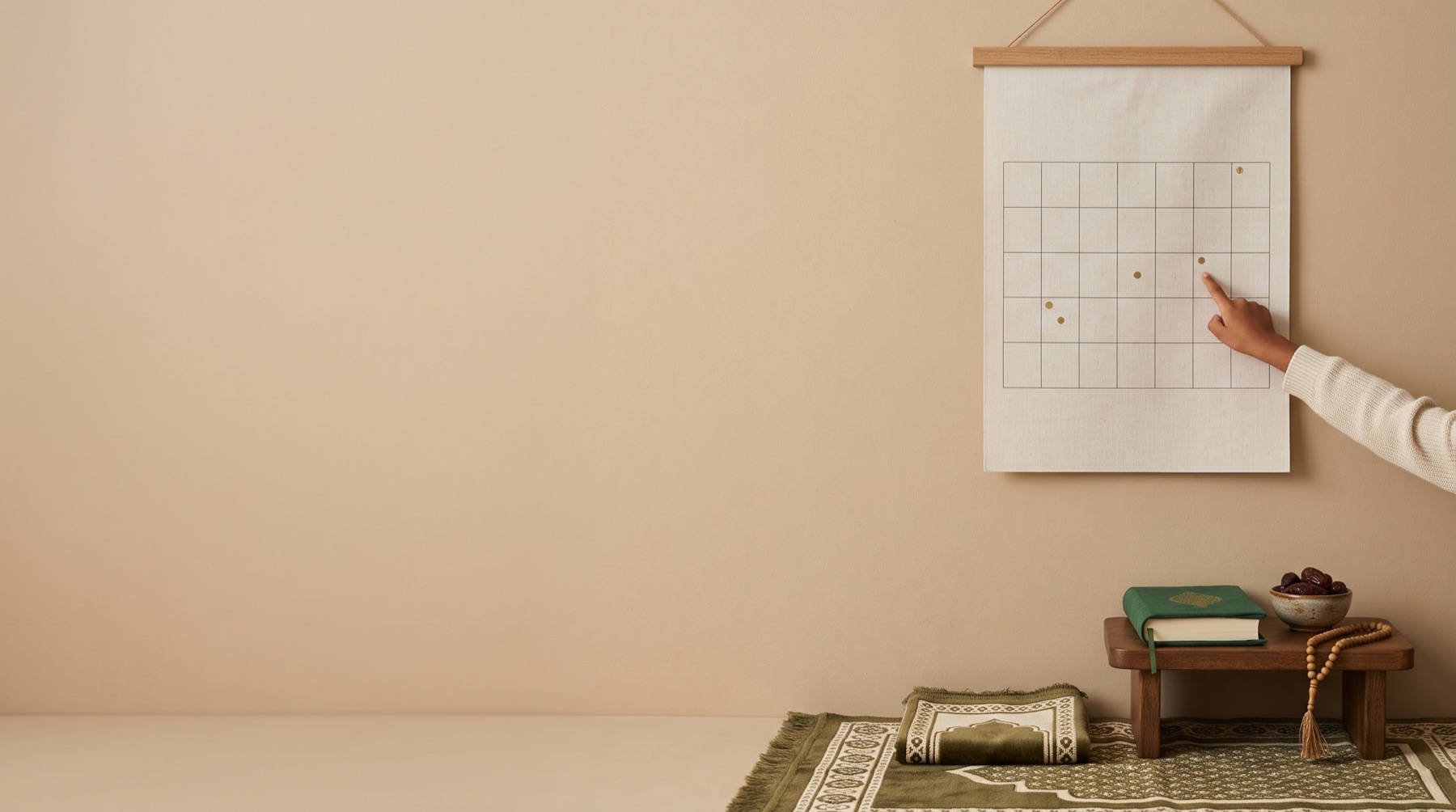
Hang a Hijri wall calendar
Put it where everyone passes, mark the key times and let your child cross off the days of the month.
Look for the crescent
On the evening a new month is expected, go outside after sunset and look low in the western sky. Seeing it is not guaranteed, which makes the moments you do see it special.
Learn the month names
Say the name of each new month at dinner. Older children can learn all twelve in order, and the Arabic script beside each one makes good reading practice.
Draw the moon
Over one month, have your child draw the moon each night it is visible, from crescent to full and back.
If your child is learning Arabic, the month names are a natural set of real words to read and write. At Radiance, the written report after every Arabic lesson shows you what to practise at home, and the month names are an easy set to add to that practice.
Questions parents ask
What is the Islamic calendar called?
It is called the Hijri calendar, because its years are counted from the Hijrah of the Prophet ﷺ from Makkah to Madinah. It is a lunar calendar of twelve months.
Why does Ramadan start earlier every year?
The lunar year is about 354 or 355 days, roughly 10–11 days shorter than the Gregorian year. So Ramadan, like every Islamic date, comes about 10–11 days earlier each year.
How many days are in an Islamic month?
Each month has 29 or 30 days, depending on when the new crescent appears.
Why do Muslims sometimes celebrate Eid on different days?
Communities follow different approaches to confirming the new moon: local sighting, sighting elsewhere or calculation. Following your local mosque is a calm way to keep your family with your community.
What is the first month of the Islamic year?
Muharram is the first month, and it is one of the four sacred months.