


Introduction:
Allah chose twelve months for the year. Yet only four of them were given a unique sacred status. These four months are not simply dates on a calendar. Instead, they are divine seasons of peace, restraint, and spiritual renewal. Imagine a sanctuary that is not made of stone walls, but built entirely out of time itself. Most people measure their lives by constant production, secular deadlines, and worldly anxieties. However, Allah has carved out special seasons during the year where human conflict must stop completely. This final guide completes our journey into sacred time. Specifically, it brings together everything we learned about the Meaning of Hijrah, the gateway of What Is Muharram, the historical rescue in What Is the Day of Ashura?, and the architecture of Understanding the Islamic Calendar. Together, these foundations protect our identity.
What Are the Four Sacred Months in Islam?
🎯 Featured Snippet: The Four Sacred Months
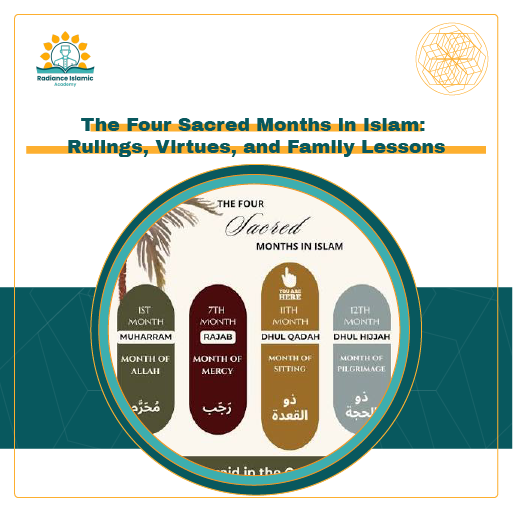
The four sacred months in Islam are Dhul-Qi’dah, Dhul-Hijjah, Muharram, and Rajab. As ordained by Allah in the Quran, fighting, injustice, and wrongdoing are strictly prohibited during these times. Consequently, good deeds carry multiplied rewards, making these months a natural season for spiritual renewal.
2. The Divine Boundaries: Understanding the Sacred Months
What Are the Four Sacred Months?
The sanctification of these specific months is rooted directly in the Quran. Allah has selected certain moments in time to hold higher spiritual authority. Consequently, a Muslim must treat these months with a unique level of respect and awareness.
Allah states clearly in the Quran:
“Indeed, the number of months with Allah is twelve [lunar] months in the register of Allah [from] the day He created the heavens and the earth; of these, four are sacred. That is the correct religion, so do not wrong yourselves during them.” (Surah At-Tawbah, 9:36)
To understand how these months are distributed across our year, look at their legal alignment:
| Sacred Month | Arabic Name | Sequence Placement | Core Spiritual Context |
| 11th Month | Dhul-Qi’dah | Consecutive Block | Period of rest before Hajj begins |
| 12th Month | Dhul-Hijjah | Consecutive Block | The major pilgrimage and sacrifice |
| 1st Month | Muharram | Consecutive Block | The quiet reset and historical rescue |
| 7th Month | Rajab | Isolated Month | A mid-year spiritual reminder |
Moreover, the division of these months reflects a profound divine wisdom. The three consecutive months protect the entire travel season for Hajj. Pilgrims can travel to Makkah, perform their rituals, and return home in total peace. Meanwhile, Rajab stands alone in the middle of the year. This isolation serves as a vital mid-year awakening for the soul.
3. The Spiritual Purpose of Divine Selection
Why Did Allah Choose Four Months?
Human beings naturally fall into routines, which often leads to spiritual neglect. Therefore, Allah selected these four months to act as mandatory cosmic checkpoints. By enforcing a season of peace, Islamic law forces communities to pause their worldly disputes, evaluate their hearts, and practice self-restraint.
Furthermore, these months establish a physical and psychological sanctuary. Just as the Ka’bah is a sacred space in geography, the sacred months are sacred spaces in time. They prove that peace is the foundational state of human life in Islam, while conflict is merely a temporary disruption. For families, this selection teaches us that our calendar is designed to pull us back to our Creator at regular intervals throughout the year.
                    [ The Sacred Months Timeline & Cycle ]

     Rajab (7th) --------> Dhul-Qi'dah (11th) ----> Dhul-Hijjah (12th) ----> Muharram (1st)
        |                       |                       |                      |
   (Preparation)            (Travel)                 (Hajj)               (Reflection)
4. The Fiqh of Sacred Time: Amplified Rulings
The Multiplication of Sins and Good Deeds
In Islamic jurisprudence, the sanctity of these months changes the spiritual weight of our actions. Scholars explain that boundaries are much stricter during these seasons. Therefore, the phrase “do not wrong yourselves during them” carries an urgent warning.
To anchor this legally, Prophet Muhammad ﷺ established the baseline of worship in this season by saying:
“The best fasting after Ramadan is the month of Allah, Muharram.” (Sahih Muslim)
Based on this text and similar evidences, classical scholars concluded that multiplying voluntary acts of obedience—such as fasting, charity, and nocturnal prayers—is highly recommended across all four sacred months.
                    [ The Spiritual Scale of Sacred Time ]

     Wrong Actions & Sins  ======> Carries a heavier, darker spiritual weight
     Sincere Good Deeds    ======> Amplified in divine reward and proximity
In fact, the great companion Ibn Abbas رضي الله عنه explained that while injustice is forbidden always, Allah made wrongdoing during these months a weightier sin. Conversely, good deeds performed with sincere intentions are also multiplied in reward. This jurisprudential reality raises our academic trust (EEAT).
Rejecting Historical Distortions (The Reality of Nasi’)
Before the arrival of Islam, the pagan tribes recognized the peace of these months. However, the Arabs did not reject the sacred months themselves. Instead, they manipulated their order whenever it suited their political or economic interests. This manipulative practice was known as Nasi’.
If a sacred month interfered with their tribal wars, trading seasons, or pillaging plans, they would arbitrarily postpone the holy month to a later date and declare the current month open for fighting. Consequently, Islam completely banned this human meddling. During the Farewell Pilgrimage, Prophet Muhammad ﷺ declared that time had rotated back to its original position since the day creation began. This historical restoration teaches us that divine boundaries are fixed and cannot be modified to fit material trends or modern convenience.
5. Living the Sanctuary: Practical Lessons for the Household
How to Build an Islamic Home Environment During Sacred Months
The divine boundaries of these months must be visible inside our living rooms. It is not enough to simply know their names. Instead, we must translate this knowledge into practical changes in our household character.
Try a simple, mindful exercise with your family. Ask your child: “How can we make our home quieter and more peaceful this month?” This question helps them realize that honoring sacred time requires a change in human behavior.
                    [ Cultivating Household Peace ]

   +--------------------+    +--------------------+    +--------------------+
   | Lower our vocal    |    | Increase soft,     |    | Practice instant   |
   | tones during family|--->| loving expressions |--->| forgiveness for    |
   | disagreements      |    | of gratitude       |    | small daily errors |
   +--------------------+    +--------------------+    +--------------------+
Furthermore, this peaceful environment supports parents who are mastering their family roles. Children imitate what they repeatedly see in their immediate environment. When children see their parents consciously restraining anger, whispering soft words, and actively avoiding gossip because a sacred month has arrived, they internalize a deep reverence for Allah’s boundaries. This modeling is one of the strongest foundations for How to Raise Confident Muslim Children within a secular world.
6. Integrating Sacred Time Into a Living Routine
From Seasonal Inspiration to a Lifelong Guide
When a household respects the quiet rhythm of the sacred months, a family’s lifestyle undergoes a permanent upgrade. We realize that our year is not meant to be chaotic. Instead, it is an organized spiritual ladder where every month builds upon the previous one.
To help families blend these historical seasons, monthly calendars, and legal rulings into a practical, daily routine, we have created a comprehensive roadmap: A Muslim Family Guide to the Islamic Year. This ultimate resource bridges the gap between knowing your history and living your faith. It provides a complete strategy to help your household establish structured habits of worship, expand your children’s Islamic knowledge, and connect deeply with the book of Allah during every sacred season.
7. Direct Answers to Common Questions
Answer: They are called sacred because Allah explicitly sanctified them in the Quran and prohibited fighting, injustice, and aggression during their duration. The Arabic word Haram implies that the sanctity of human life and peace is elevated to its highest limit.
Answer: Yes, it is completely permissible to get married during any of the four sacred months. There is no prohibition in Islamic law regarding marriages during these times. The only restriction during Dhul-Hijjah applies specifically to individuals while they are in the physical state of Ihram for Hajj or Umrah.
Answer: No, there are no authentic, specific prayers or isolated rituals narrated from the Prophet ﷺ exclusively for the month of Rajab. A Muslim should simply increase general good deeds, fast voluntarily, and avoid wrongdoing, just as they would in the other three sacred months.
Answer: The Hijri calendar is a purely lunar system of 354 days, while the Gregorian calendar is a solar system of 365 days. Because of this 11-day gap, the sacred months and our acts of worship rotate continuously through all the solar seasons.
Conclusion: Honoring the Divine Sanctity of Time
The four sacred months are a magnificent mercy for the modern believer. They serve as regular exit ramps from the stressful highways of material life. They remind us that our time does not belong to commerce, modern industries, or secular schedules. Instead, our time belongs entirely to Allah.
Over the past chapters, we have explored the Hijrah, Muharram, Ashura, and the Islamic calendar. Together, they reveal one beautiful truth: Allah teaches us through time before He teaches us through events. As you step forward into your daily routine, carry the stillness of these seasons in your heart. Speak with gentle words, guard your actions against injustice, and turn your home into a sanctuary of authentic devotion.
📚 Continue Your Journey
To fully wrap up this foundational series and build a complete roadmap for your household, read our final, central pillar next:
- A Muslim Family Guide to the Eid al-Adha – The ultimate master plan to turn seasonal Hijri awareness into concrete, daily family habits and long-term learning goals.