


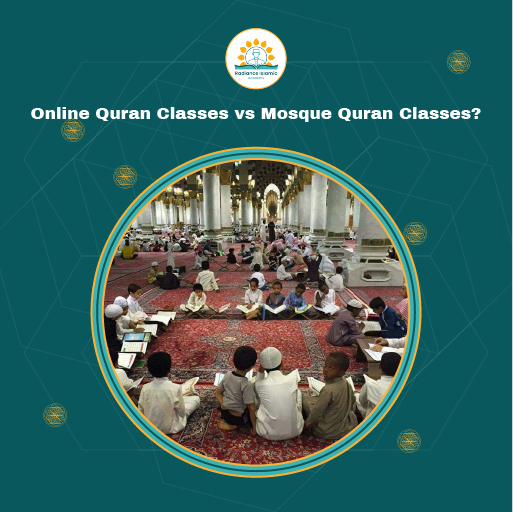
Online Quran classes vs mosque Quran classes is an important comparison for families who want Quran learning but need the right balance of correction, routine, flexibility, safety, and community.
Mosque Quran classes feel familiar, trusted, and connected to the local Muslim community.
Online Quran classes feel flexible, convenient, and easier to fit around school, work, travel, and family schedules.
Both can be valuable.
The better choice depends on the student’s age, current level, learning goal, teacher access, correction needs, safety expectations, and learning style.
Some children benefit from the community feeling of a mosque class.
Others may need the focused correction of an online one-to-one lesson.
An adult may prefer the privacy of online learning, while another learner may feel more motivated by attending a local mosque regularly.
This article compares online Quran classes and mosque Quran classes so parents and students can choose the format that fits their level, routine, correction needs, and long-term consistency.
Quick Answer: Online Quran Classes vs Mosque Quran Classes
Online Quran classes are usually better when the student needs flexible scheduling, private correction, access to a specific teacher, one-to-one support, or lessons from home.
Mosque Quran classes may be better when the student benefits from local community, in-person routine, peer motivation, and direct connection to the mosque environment.
Use this rule:
- Choose online Quran classes when flexibility and personal correction matter most.
- Choose mosque Quran classes when community, local routine, and in-person learning matter most.
- Choose a mixed path when the student needs both teacher correction and community connection.
The strongest choice is not automatically online or mosque.
It is the class that gives the student enough correction, consistency, safety, and progress.
Where Online and Mosque Quran Classes Fit in the Learn Quran Online Path
For the full learning-path overview, start with Learn Quran Online: A Step-by-Step Guide for Every Level.
To compare all learning methods, continue with What Is the Best Way to Learn Quran Online?.
Families choosing between class formats can review Private vs Group Quran Classes: Which Is Better?.
Students who need focused reading correction may continue with Learn Quran Reading Online with a Teacher.
Parents planning Quran lessons for children can also read Learn Quran Online for Kids: A Parent’s Guide.
This article focuses only on one comparison:
whether online Quran classes, mosque Quran classes, or a mixed path gives the student the right balance of correction, routine, flexibility, safety, and community.
Do Not Compare Online and Mosque Quran Classes by Convenience Alone
Do not choose online classes only because they are easier to schedule.
Mosque classes should not be chosen only because they feel more traditional or familiar.
The real question is what the student needs to improve.
A learner who needs close pronunciation, Tajweed, reading, or Hifz correction may need more individual teacher attention.
Community, routine, and in-person motivation may matter more for students who learn better through local connection.
Safety, teacher quality, class size, parent communication, and progress tracking should also guide the decision.
The best format is the one that helps the student learn accurately and continue consistently.
The Main Difference: Flexibility vs Community
Online and mosque Quran classes solve different problems.
| Area | Online Quran Classes | Mosque Quran Classes |
|---|---|---|
| Schedule | More flexible | Fixed class times |
| Teacher access | Wider choice | Limited to local teachers |
| Community | Lower unless built intentionally | Strong local connection |
| Parent convenience | High from home | Requires travel |
| Personal correction | Strong in private lessons | Depends on class size |
| Peer motivation | Depends on format | Often stronger |
| Safety checks | Must be verified online | Must still be verified locally |
| Backup options | Depends on provider | Depends on mosque system |
The decision should not be based on format alone.
A strong online class can be better than a weak local class.
A strong mosque class can be better than a weak online class.
When Online Quran Classes May Be Better
Online Quran classes may be a better fit when the student needs convenience, flexibility, or a teacher matched to a specific goal.
Online learning may help when:
- The family has a busy schedule
- Local mosque classes are too far away
- The student needs one-to-one correction
- The child feels shy in a group
- The adult wants privacy
- The student needs Tajweed, Hifz, or pronunciation support
- Parents want more control over lesson timing
- The student needs a teacher who matches their level
If the decision is mainly about choosing a structured provider, Online Quran Academy vs Private Tutor explains how to compare academy systems and individual tutors.
When Mosque Quran Classes May Be Better
Mosque Quran classes may be a better fit when the student benefits from in-person community and routine.
They may help when:
- The mosque has a qualified Quran teacher
- The class is well organized
- Students are grouped by level
- The child enjoys learning with peers
- Parents value local community connection
- The schedule is easy to maintain
- The student is motivated by attending in person
Mosque classes can also help children feel that Quran learning is part of Muslim community life, not only a private home activity.
That community value should not be ignored.
Correction Still Matters in Both Formats
Whether the class is online or in a mosque, Quran learning still needs correction.
The teacher should listen carefully and identify repeated mistakes.
Correction Check
| Question | Why It Matters |
|---|---|
| Does each student read or recite? | Shows active participation |
| Does the teacher correct mistakes? | Protects accuracy |
| Are students grouped by level? | Prevents mismatch |
| Is progress tracked? | Shows improvement |
| Is home review clear? | Supports consistency |
A mosque class is not automatically strong because it is in person.
An online class is not automatically strong because it is private.
The key is meaningful teacher feedback.
Online vs Mosque Quran Classes for Children
For children, the best format depends on attention, confidence, safety, and correction needs.
Online classes may help children who need personal correction, shorter lessons, or a quieter environment.
Mosque classes may help children who enjoy peer learning, local community, and in-person routine.
For parents choosing the best child learning path, Best Online Quran Classes for Kids can help compare teacher quality, class format, safety, trial lessons, and parent support.
Parents should also check online safety carefully. A trusted external resource such as NSPCC online safety guidance can help families think about privacy, supervision, reporting, and safer online habits before choosing any online learning setup.
Online vs Mosque Quran Classes for Hifz
Hifz can work online or in a mosque, but the system must protect revision.
The teacher should check:
- New memorization
- Recent revision
- Older portions
- Pronunciation mistakes
- Prompt dependence
- Retention over time
If a child is memorizing Quran, Complete Guide to Quran Memorization for Kids explains why revision, retention, and teacher listening matter more than simply adding new portions.
The format is secondary.
The revision system is primary.
Cost and Time: What Families Should Compare
Cost is not only the lesson price.
Families should also compare travel, time, consistency, and correction quality.
| Factor | Online | Mosque |
|---|---|---|
| Travel time | None | Often required |
| Lesson cost | Varies | Often lower or community-based |
| Schedule control | Higher | Lower |
| Teacher choice | Wider | Local |
| Parent supervision | Easier at home | Depends on setup |
| Community benefit | Lower | Higher |
A lower-cost class is not always better if the student receives little correction.
A more flexible online class is not always better if the student becomes isolated or inconsistent.
The Best Option May Be a Mixed Path
Some families do not need to choose only one.
A mixed path may work well.
Online lesson for personal correction
↓
Short home practice
↓
Mosque class for community and routine
↓
Regular progress check
For example:
- Online private lesson for pronunciation correction
- Mosque class for community participation
- Online Hifz check for revision
- Mosque program for group learning
- Online trial assessment before choosing a path
A mixed path should have clear roles.
Do not repeat the same lesson in two places without knowing what each one is doing.
Questions to Ask Before Choosing
Before choosing online or mosque Quran classes, ask:
- What is the student’s main goal?
- Does the student need personal correction?
- Is the mosque class level-matched?
- Is online safety clear?
- Is the teacher qualified for this goal?
- Does the child need peers or privacy?
- Is the schedule realistic?
- How will progress be checked?
- Is home practice clear?
If several answers are unclear, start with an assessment before committing.
How Radiance Islamic Academy Supports Online Quran Learning
After comparing online and mosque Quran classes, the practical question becomes:
“How can an online academy provide structure, correction, and parent confidence?”
At Radiance Islamic Academy, the learning path should be based on the student’s age, reading level, pronunciation needs, confidence, schedule, and learning goals.
During an assessment, the teacher can check:
- Quran reading level
- Pronunciation needs
- Recitation confidence
- Tajweed readiness
- Hifz and revision needs
- Child attention needs
- Suitable lesson format
- First measurable learning goal
After the assessment, the student or parent should receive a clear recommendation explaining whether online one-to-one learning, group learning, extra practice, or another path is more suitable.
Learn More About Radiance Islamic Academy
Students and parents can visit Radiance Islamic Academy’s official Facebook, Instagram, and WhatsApp channels to see academy updates, announcements, communication style, and how learners can ask questions before choosing a class.
These official channels provide an additional view of the academy’s communication. However, the main decision should still depend on teacher quality, safety, assessment, correction needs, lesson structure, and student support.
Common Mistakes When Choosing Online or Mosque Quran Classes
Avoid these mistakes:
- Choosing only because a class is nearby
- Choosing only because online is convenient
- Assuming mosque classes always give enough correction
- Assuming online classes always provide personal attention
- Ignoring child safety online
- Ignoring class size in mosque programs
- Choosing without checking teacher qualifications
- Not asking how progress is tracked
- Starting Hifz without a revision plan
- Keeping the same class when repeated mistakes do not improve
The best class is the one that helps the student learn accurately and consistently.
Frequently Asked Questions
Online Quran classes are better when the student needs flexibility, private correction, or access to a specific teacher. Mosque classes may be better for community, in-person routine, and peer motivation.
Mosque classes can be good for kids when the teacher is qualified, the group is organized, and each child gets attention. Online classes may be better for children who need closer correction or flexible timing.
They can replace some learning needs, especially reading correction, Tajweed, pronunciation, or Hifz support. However, mosque classes may still provide community connection.
Mosque classes are often lower-cost or community-based, but families should compare correction quality, travel time, consistency, and progress tracking.
Yes. A child can use online lessons for personal correction and mosque classes for community and routine, as long as both paths have clear roles.
Conclusion: Choose the Format That Fits the Learning Need
Online Quran classes and mosque Quran classes can both be valuable.
Mosque classes can provide community, routine, and in-person connection.
Online classes can provide flexibility, teacher choice, personal correction, and home convenience.
The strongest choice depends on the student’s real need.
For one child, mosque learning may build motivation.
“In other scenarios, online one-to-one correction may be essential.”
For one adult, online privacy may help.
For another, mosque attendance may create consistency.
Do not choose only by convenience, tradition, or price.
Choose the format that provides teacher quality, safety, correction, consistency, and measurable progress.
Next Step
If you want to choose a complete learning path, continue with How to Choose the Right Online Quran Program.
If you are comparing provider types, continue with Online Quran Academy vs Private Tutor.
When selecting a program for a child, continue with Best Online Quran Classes for Kids.
If you are unsure whether online, mosque, or a mixed path fits your level, begin with a Free Quran Assessment.