


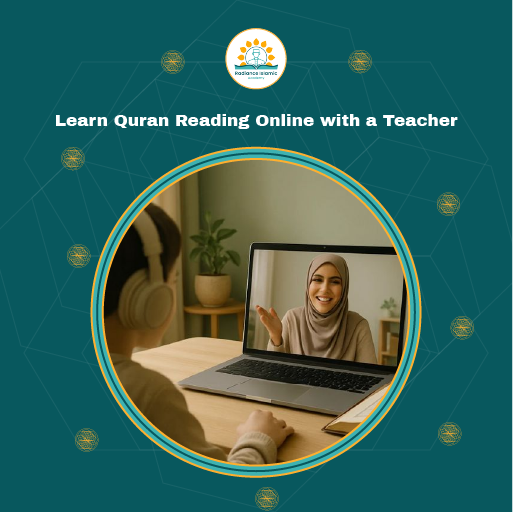
Learn Quran reading online with a teacher is helpful when a student can recognize some letters or words but still reads with hesitation, guessing, or frequent pauses.
Some learners know Arabic letters but cannot join them smoothly.
Others open the Mushaf and recognize parts of the page, yet wait for someone else to say the word first.
Parents may notice the same pattern with children. A child may repeat short surahs by listening, read a few simple words, or know some letters, but still struggle when asked to read from the page.
That is where guided Quran reading matters.
A teacher can listen, correct, slow the pace, review weak foundations, and help the student move from guessing to accurate reading.
This article explains how online Quran reading with a teacher can build confidence, correction, and real reading progress step by step.
Quick Answer: How to Learn Quran Reading Online with a Teacher
To learn Quran reading online with a teacher, the student should begin from their current reading level.
A good teacher can check whether the learner needs:
- Arabic letter review
- Vowel practice
- Joining letters
- Noorani Qaida
- Guided Quran reading
- Reading fluency
- Pronunciation correction
- Tajweed later
The goal is not to read fast immediately.
The goal is to read with better accuracy, fewer guesses, clearer sounds, and more confidence.
Teacher-led Quran reading works best when the student reads aloud, receives correction, practises short examples, and reviews the same weak points until reading becomes more stable.
Where Quran Reading Online with a Teacher Fits in the Learn Quran Path
For the full learning-path overview, start with Learn Quran Online: A Step-by-Step Guide for Every Level.
When initiating baseline foundational instruction, continue with How to Start Reading Quran from Zero.
For students choosing between foundation review and direct Quran reading, continue with Noorani Qaida or Quran Reading: Where Should You Start?.
For learners deciding between self-study and teacher correction, continue with Can You Teach Yourself to Read the Quran?.
This article focuses only on one learning need:
how a teacher helps students move from slow, uncertain, or guessed reading into clearer Quran reading with live correction and guided practice.
Slow Quran Reading Is Not the Same as Guessing
A student may read slowly and still be reading correctly.
Slow reading usually means the learner is trying to decode the letters, vowels, and word patterns carefully.
Guessing is different.
Guessing often means the student is waiting for a familiar shape, memory, or another person’s prompt instead of reading the word independently.
| What You Notice | What It May Mean |
|---|---|
| Student reads slowly but follows the letters | Reading is developing |
| Student pauses before each word | More practice may be needed |
| Student waits for help before trying | Confidence or decoding may be weak |
| Student guesses from memory | Reading foundation needs review |
| Student repeats the same word after correction | Teacher-led practice is needed |
| Student reads better with short examples | Guided reading may be working |
This distinction helps the teacher choose the right next step.
A slow reader may need practice and confidence.
A guessing reader may need foundation review, Noorani Qaida support, or more structured teacher correction.
The goal is not to rush the student.
The goal is to help them read from the page with less guessing and more control.
Without correction, a student may practise the same mistake for weeks without noticing.
Quran Reading Is Not the Same as Reciting from Memory
Some students can repeat short surahs because they have heard them many times.
That is valuable.
But repeating from memory is not always the same as reading.
A student may know how a surah sounds but still be unable to identify the letters, vowels, or word structure on the page.
This difference matters.
Reading vs Memory
| Skill | What It Shows |
|---|---|
| Reciting from memory | The student remembers what they heard |
| Recognizing letters | The student can identify written forms |
| Reading vowels | The student can produce short sounds |
| Joining letters | The student can build words |
| Reading unfamiliar words | The student is decoding, not guessing |
| Reading with correction | The student is improving accuracy |
A useful test is to ask the student to read a short unfamiliar word or portion.
If the student can read only familiar surahs, memory may still be doing most of the work.
A teacher can tell whether the student is truly reading or relying mostly on memory.
That is why guided reading is important.
Who Needs Teacher-Led Quran Reading?
Teacher-led Quran reading is useful for students who already have some foundation but need correction and confidence.
It can help complete beginners after they learn letters, and it can also help students who learned years ago but feel rusty.
You May Need Teacher-Led Reading If…
| Situation | What It May Mean |
|---|---|
| You know letters but cannot read smoothly | Guided reading may help |
| You guess short words | Decoding needs support |
| You skip vowels | Reading accuracy needs correction |
| You pause too often | Fluency needs practice |
| You confuse similar letters | Teacher listening is needed |
| You read from memory only | Written reading should be checked |
| You feel nervous reading aloud | Confidence needs support |
Teacher-led reading is especially useful when the same mistake continues even after self-practice.
Repeated mistakes often need live listening, not more independent repetition.
A teacher-led reading class should meet the student where they are.
It should not push too far ahead or keep the student too long in basics.
Reading Assessment: What Should the Teacher Check?
A good Quran reading assessment should be simple and practical.
It should not feel like a stressful exam.
The goal is to identify the first weak skill.
Quran Reading Assessment
During an assessment, the teacher can check:
- Letter recognition
- Vowel reading
- Connected letters
- Short-word reading
- Reading without guessing
- Similar-letter mistakes
- Reading pace
- Confidence while reading aloud
The assessment should also distinguish between:
- A foundation problem
- A reading fluency problem
- A pronunciation problem
- A confidence problem
- A mixed weakness
These problems may look similar during reading, but they do not need the same lesson plan.
The result should answer three questions:
- What can the student already read?
- What mistake appears repeatedly?
- What should the next reading goal be?
If the student is not ready for guided Quran reading yet, Noorani Qaida or Quran Reading: Where Should You Start? gives a focused readiness guide.
Not Sure If You Need Reading Foundations or Guided Reading?
Some students are in the middle.
The baseline includes knowing letters
They understand some vowels.
They can read a few short words.
But they still hesitate, guess, or depend heavily on help.
These students may not need to restart from the beginning.
They may need a mixed transition plan.
Mixed Reading Support Plan
| Part of Lesson | Purpose |
|---|---|
| Short foundation review | Fix weak letters, vowels, or joining |
| Guided Quran reading | Practise real reading |
| Teacher correction | Catch repeated mistakes |
| Short home task | Reinforce one weak skill |
| Next lesson check | See whether reading is improving |
A mixed plan is most useful when the student can already read some short words but still struggles with specific vowels, joined forms, or repeated guessing.
The student should not restart every beginner lesson automatically.
The teacher should review only the weak foundation skills that are blocking Quran reading.
This prevents two common problems:
starting Quran pages too early, or staying in beginner material too long.
How a Teacher Helps Improve Quran Reading
A teacher does more than listen.
A good teacher identifies patterns.
They notice what mistake repeats and what should be corrected first.
What a Teacher Can Notice
| Reading Issue | Teacher Response |
|---|---|
| Student guesses words | Slow down and decode |
| Vowels are skipped | Practise short sounds |
| Similar letters are confused | Repeat and compare sounds |
| Reading is rushed | Build pace gradually |
| Student freezes | Use smaller portions |
| Mistake repeats | Make it the correction focus |
This is where live teaching becomes valuable.
The teacher can adjust while the student is reading.
A video cannot do that.
Which Reading Mistake Should Be Corrected First?
A teacher may hear several mistakes in one lesson.
The first correction focus should usually be the mistake that:
- Repeats most often
- Affects many words
- Prevents accurate decoding
- Causes the student to guess
- Can be practised clearly between lessons
Correcting the highest-impact mistake first often improves more than giving many small corrections at once.
Live Teacher Correction vs Self-Study
Self-study can help with exposure and review.
It can help students practise letters, listen to recitation, or repeat a short portion.
But Quran reading needs correction.
A student may not hear their own mistakes.
They may think they are reading correctly because the word sounds familiar.
They may skip small details without noticing.
Self-Study vs Teacher-Led Reading
| Self-Study | Teacher-Led Reading |
|---|---|
| Helps with exposure | Gives personal correction |
| Useful for review | Identifies repeated mistakes |
| Follows a general pace | Adjusts to the student |
| Cannot hear pronunciation | Listens and corrects |
| May build confidence | Builds accuracy with feedback |
Self-study is useful for review, but it should not become repeated practice without feedback.
Practising the same mistake many times can make the habit stronger.
Self-study is useful when it supports a teacher-led plan.
It becomes risky when it replaces correction completely.
If you are comparing both options, Online Quran Teacher vs Learning by Yourself explains this decision in more detail.
What Should a Quran Reading Lesson Look Like?
A Quran reading lesson should feel structured.
The student should know what they are reading, what mistake is being corrected, and what to practise before the next lesson.
Simple Quran Reading Lesson Flow
Short review
↓
Student reads a small portion aloud
↓
Teacher identifies the most repeated mistake
↓
Teacher models the correction
↓
Student reads the same word or line again
↓
Student applies the correction in a new example
↓
One short home practice task
The lesson should not try to fix everything at once.
One clear correction can be more useful than ten scattered comments.
Applying the correction in a new example matters because it shows whether the student understood the pattern or only repeated one corrected word.
From Slow Reading to Fluency
Fluency does not mean reading quickly from the beginning.
It means reading with fewer pauses, fewer guesses, and more confidence.
A student becomes more fluent when they can recognize patterns and correct mistakes before they become habits.
Signs Reading Fluency Is Improving
| Sign | What It Shows |
|---|---|
| Fewer guesses | Decoding is improving |
| Fewer repeated mistakes | Correction is working |
| Less help needed | Independence is growing |
| Better pace | Reading confidence is improving |
| More stable vowels | Accuracy is improving |
| Calmer reading aloud | Confidence is stronger |
Fluency should not be measured by speed alone.
A more fluent reader:
- Guesses less
- Pauses in more suitable places
- Recognizes familiar patterns faster
- Needs fewer reminders
- Maintains accuracy across a longer portion
- Recovers more calmly after a mistake
Reading faster with more mistakes is not stronger fluency.
Progress may be slow at first.
That is normal.
The goal is steady improvement, not sudden speed.
Quran Reading for Children
Children can learn Quran reading online with a teacher when lessons are short, active, gentle, and matched to their level.
A child’s lesson may include:
- Brief letter or word review
- Short guided reading
- One correction focus
- Gentle repetition
- Parent feedback
- One small review task
The parent should support the routine without answering for the child or correcting over the teacher.
For the full child learning path, continue with Learn Quran Online for Kids: A Parent’s Guide.
When Quran Reading Should Come Before Structured Tajweed
Simple pronunciation correction can begin from the first lesson.
However, structured Tajweed study may be too early if the student cannot decode short words, read vowels, or join letters confidently.
A practical order may be:
Reading foundations
↓
Guided Quran reading
↓
Simple pronunciation correction
↓
More structured Tajweed study
Reading and Tajweed can overlap, but the lesson should not overload a student whose decoding skills are still weak.
If pronunciation is already the main challenge, Learn Quran Online with Tajweed explains the next path.
When Reading Supports Hifz
Quran memorization becomes stronger when reading is also developing.
Reading and memorization should be tracked as separate skills.
A student may memorize accurately by listening while still needing support with written reading.
A student may memorize by listening, but reading helps them review, recognize mistakes, and retain more confidently.
Before increasing Hifz, check whether the student can:
- Read short words
- Accept correction
- Review old portions
- Avoid repeating the same mistake
- Follow a revision plan
If the student is a child moving toward memorization, Complete Guide to Quran Memorization for Kids explains how reading, correction, revision, and consistency support long-term Hifz.
How to Practise Quran Reading Between Lessons
Practice should be short and focused.
The student does not need to reread everything.
A useful practice task may be:
- One short line
- One repeated word
- One vowel pattern
- One similar-letter pair
- One corrected mistake
- One short portion from the lesson
Ask the teacher for one priority before the next class.
When possible, practise from the same teacher-corrected example.
The goal is not long homework.
The goal is repeating the correct pattern accurately.
Focused review is easier to maintain than long, unclear homework.
Record a Quran Reading Starting Point
Before regular lessons begin, record a short baseline.
For example:
- Recognizes most letters
- Reads vowels with some help
- Guesses joined words
- Confuses two similar letters
- Reads familiar surahs from memory
- Pauses frequently
- Feels nervous reading aloud
After several lessons, compare the student with the same skills.
This makes progress easier to see and prevents parents or students from relying only on memory.
How to Know If Quran Reading Is Improving
Parents and students should track reading progress by accuracy, not only quantity.
Reading Progress Check
Every few weeks, ask:
- Is the student guessing less?
- Can they read unfamiliar words more confidently?
- Are vowel mistakes decreasing?
- Are repeated mistakes being corrected?
- Is reading pace becoming steadier?
- Is confidence improving?
A useful progress test is whether the student can apply correction to a different word or line without being reminded every time.
That shows the student is learning the pattern, not only repeating one corrected example.
For a fuller tracking system, How Parents Can Track Quran Learning Progress explains how to record skills, repeated mistakes, revision, and milestones.
What Makes a Good Online Quran Reading Teacher?
A good Quran reading teacher should:
- Listen carefully before correcting
- Identify patterns, not only isolated mistakes
- Adjust the level and pace
- Give one clear correction focus
- Allow the student time to try again
- Protect confidence while maintaining accuracy
- Give short, specific home practice
- Explain the next learning goal clearly
The teacher should not simply finish pages.
The teacher should help the student become a more independent reader.
Common Mistakes When Learning Quran Reading Online
Avoid these mistakes:
- Starting with full Quran pages before foundations are ready
- Relying only on videos
- Repeating the same reading mistake without live correction
- Measuring progress only by speed
- Correcting too many reading problems in the same lesson
- Skipping short home review
- Ignoring repeated vowel mistakes
- Moving to Hifz before reading is stable
- Comparing one student’s reading pace with another
- Measuring fluency only by speed
- Restarting all beginner material when only one foundation skill is weak
- Moving to new pages before the main repeated mistake improves
Quran reading improves when correction is specific and practice is consistent.
How Radiance Islamic Academy Supports Quran Reading Online
After understanding how teacher-led Quran reading should work, the next question is practical:
“How can an academy help students move from slow or uncertain reading to greater accuracy and confidence?”
At Radiance Islamic Academy, the Quran reading path should be based on the student’s current reading ability, repeated mistakes, confidence, and learning goals.
During an assessment, the teacher can check:
- Letter recognition
- Vowel reading
- Connected-letter reading
- Short-word reading
- Reading without guessing
- Similar-letter confusion
- Repeated mistakes
- Reading pace
- Confidence while reading aloud
After the assessment, the student or parent should receive a clear recommendation explaining:
- Whether foundation review is needed
- Whether guided Quran reading can begin
- The first correction focus
- The recommended lesson style
- The first measurable reading goal
Learn More About Radiance Islamic Academy
Students and parents can visit Radiance Islamic Academy’s official Facebook, Instagram, and WhatsApp channels to see academy updates, announcements, communication style, and how learners can ask questions before choosing a class.
These official channels provide an additional view of the academy’s communication. However, the main decision should still depend on teacher quality, reading assessment, correction style, lesson structure, and student support.
Final Reading Readiness Checklist
Before choosing a Quran reading course online, ask:
- Can the student recognize Arabic letters?
- they read vowels?
- Can they join letters into short words?
- Are they reading or guessing?
- Do they need Noorani Qaida first?
- Can they read aloud with teacher support?
- What mistake repeats most often?
- Is the lesson pace realistic?
- Is there a short home review task?
- Is progress being checked over time?
If several answers are unclear, begin with an assessment before choosing a full course.
Frequently Asked Questions
Yes, you can learn Quran reading online with a teacher when lessons include live reading, correction, repeated mistake tracking, and short practice between lessons.
Some students need Noorani Qaida if they cannot join letters or read short words. Others may begin guided Quran reading if their basics are already strong enough.
Not always.
Slow reading is normal for many beginners.
The main concern is whether the student is decoding the words accurately or guessing, skipping vowels, and waiting for help.
Accuracy should improve before speed becomes the main goal.
A teacher is strongly recommended because Quran reading depends on live listening and correction.
Students often cannot hear their own repeated mistakes, and independent practice may strengthen an incorrect habit.
A teacher can identify the pattern, model the correction, and check whether it is applied in new words.
Yes.
Short self-practice can support progress when it follows the teacher’s correction.
Use one short line, word pattern, or repeated mistake from the lesson.
Avoid long practice if you are unsure whether you are repeating the sound correctly.
Yes, children can learn Quran reading online when lessons are short, interactive, gentle, and matched to their level.
It depends on the student’s starting level, lesson frequency, correction, and practice. Steady reading improvement usually comes from consistent guided correction.
Quran reading focuses on recognizing letters, vowels, words, and reading from the page. Tajweed focuses more on pronunciation rules and recitation quality.
Conclusion: Teacher-Led Reading Builds Accuracy and Confidence
Learning Quran reading online with a teacher helps students move from uncertainty to clearer reading.
The teacher listens.
The student reads.
Mistakes are corrected.
Weak patterns are noticed.
And progress becomes easier to track.
The best Quran reading path starts from the student’s real level.
Some students need foundation review.
are ready for guided Quran reading.
Some need pronunciation support.
Some mainly need confidence reading aloud.
Progress comes from live listening, focused correction, short accurate practice, and repeated review.
When the student learns to decode with fewer guesses and apply correction more independently, online Quran reading becomes clearer, calmer, and more fluent.
Next Step
If pronunciation is your main challenge, continue with Learn Quran Pronunciation Online.
you can read but want smoother, more confident recitation, continue with Learn Quran Recitation Online for Beginners.
If you are unsure whether you need Noorani Qaida or guided reading, continue with Noorani Qaida or Quran Reading: Where Should You Start?