


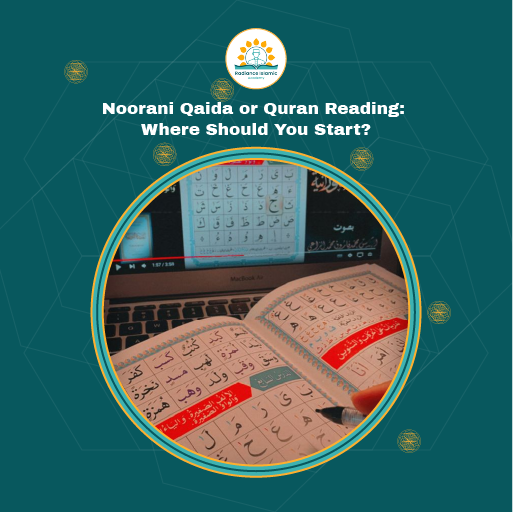
Noorani Qaida or Quran reading? The right choice depends on whether the learner can already recognize letters, read vowels, and join Arabic words with confidence.
If the student still guesses words, confuses vowel marks, or cannot connect letters smoothly, Noorani Qaida is usually the safer bridge.
If the student can already read short Quranic words slowly, guided Quran reading may be the better next step.
The goal is not to stay in beginner material too long.
It is also not to open the Mushaf before the reading foundation is ready.
This article helps parents and beginners decide whether to start with Noorani Qaida, Quran reading, or a mixed transition plan.
Where This Fits in the Learn Quran Online Path
For the full learning-path overview, start with Learn Quran Online: A Step-by-Step Guide for Every Level.
If you are unsure of the very first starting point, continue with Where Should a Quran Beginner Start?.
If you are starting from zero, continue with How to Learn Quran Online as a Complete Beginner.
If not knowing Arabic is the main concern, continue with Can You Learn Quran Online Without Knowing Arabic?.
This article focuses only on one transition decision:
whether Noorani Qaida, Quran reading, or a mixed plan is the best next step for the learner’s current level.
A Note for Parents
If your child can repeat short surahs by listening, that is valuable, but it does not always mean the child can read Quran words independently.
Listening memory and reading ability are different skills.
A child may know how a surah sounds but still need help recognizing letters, reading vowels, and joining words.
That is normal.
Do not push Quran pages too early if the foundation is weak.
And do not keep the child in beginner material too long if they are already ready to read.
The goal is to choose the step that protects confidence and builds real reading ability.
Quick Answer: Noorani Qaida or Quran Reading?
Start with Noorani Qaida if the student cannot recognize letters confidently, struggles with vowel marks, cannot join letters into words, or guesses instead of reading.
Start with Quran reading if the student already knows letters, understands basic vowels, can read short connected words, and mainly needs guided practice with correction.
Choose a mixed transition plan if the student knows the basics but still has weak spots. In that case, the teacher may combine short Quran reading with selected Noorani Qaida review.
The best choice depends on readiness, not age or ambition.
A 5-Minute Readiness Test
Use this simple test before choosing between Noorani Qaida and Quran reading.
The goal is not to give the student a stressful exam. The goal is to identify the first weak skill.
Ask the student to do five small tasks.
1. Can the student recognize Arabic letters?
Show the student a small selection of Arabic letters in separate and connected forms, including commonly confused letters.
Can the student identify them without guessing or waiting for help?
If the answer is no, Noorani Qaida is usually the better starting point.
2. Can the student read basic vowel marks?
Ask the student to read letters with fatha, kasra, and damma.
If they know the letters but cannot read the short sounds, they need more foundation before Quran reading.
3. Can the student recognize connected letters?
Show simple joined letters or short word patterns.
If connected letters look confusing, the student is not ready for full Quran reading yet.
4. Can the student read short words?
Ask the student to read a few short Arabic or Quranic words slowly.
If they cannot read short words, Quran pages may feel overwhelming.
5. Can the student read without guessing?
This is the most important part.
If the student is guessing from memory, shape, or sound, they may appear more ready than they really are.
True readiness means the student can look at the word and read it, even slowly.
Reading slowly is acceptable at this stage. The important question is whether the student is decoding the word independently or waiting for someone to say it first.
Readiness Test Result
Use this result guide.
| Test Result | Best Starting Point |
|---|---|
| Student cannot recognize letters | Noorani Qaida |
| Student knows letters but struggles with vowels | Noorani Qaida |
| Student knows vowels but cannot join letters | Noorani Qaida |
| Student can read short words slowly | Guided Quran reading |
| Student reads short words but has weak spots | Mixed transition plan |
| Student reads Quran but makes pronunciation mistakes | Quran reading with correction |
| Student is unsure or nervous | Short assessment lesson |
This is the main decision point.
If the student cannot read short connected words, start with Noorani Qaida.
If the student can read short words but needs confidence, start guided Quran reading.
If the student is in between, use a mixed transition plan.
What Is Noorani Qaida Best For?
Noorani Qaida is best for students who still need the reading foundation.
It helps students move from recognizing letters to reading Quranic words step by step.
Noorani Qaida usually supports:
- Letter recognition
- Correct sounds
- Vowel marks
- Joining letters
- Sukoon
- Shaddah
- Madd letters
- Short word patterns
- Early pronunciation habits
Noorani Qaida is not a delay if the foundation is weak.
It is a bridge.
A student who cannot read short words confidently often benefits from this bridge before moving into Quran pages.
What Is Quran Reading Best For?
Quran reading is best for students who already have the basic reading tools.
The student does not need to be fluent.
But they should be able to recognize letters, read vowels, join letters, and read short words without constant guessing.
Guided Quran reading may include:
- Reading short Quran passages
- Correcting repeated mistakes
- Improving pace
- Practising difficult words
- Learning where to stop
- Building confidence with the Mushaf
Quran reading is not only “open the page and read.”
It should still include teacher listening and correction.
The difference is that the student is ready to practise from Quranic text instead of staying only with foundation drills.
When a Mixed Transition Plan Is Better
Some students do not fit neatly into one side.
They know the letters.
They understand some vowels.
They can read a few short words.
But they still hesitate, guess, or struggle with joined words.
For these students, the best answer is not always full Noorani Qaida or full Quran reading.
A mixed transition plan may work better.
What a Mixed Transition Plan Looks Like
| Part of Lesson | Purpose |
|---|---|
| Short Noorani Qaida review | Fix weak letters, vowels, or joining |
| Short Quran reading | Build confidence with real Quranic text |
| Teacher correction | Catch repeated mistakes early |
| Practice task | Reinforce the exact weak point |
| Next class check | See whether the student is ready to move forward |
This plan helps students avoid two common problems:
staying too long in beginner material, or moving too quickly into Quran pages.
It gives the student a bridge while still allowing real reading progress.
What If the Student Is Starting from Zero?
If the student does not know letters yet, the answer is simple.
Do not begin directly with Quran reading.
Start with the alphabet, sounds, vowels, and simple joining before moving forward.
That does not mean the student is behind. It only means the foundation needs to be built first.
If the student is starting from nothing, How to Start Reading Quran from Zero gives a more practical first-stage plan.
What If the Student Is a Child?
For children, the decision should be gentle.
Some children can repeat short surahs beautifully because they learned them by listening. But when they see the written words, they may not know how to read them.
That means they have listening familiarity, not reading readiness yet.
Before moving a child into Quran reading, check whether they can recognize letters, read vowels, join letters, and read short words without guessing.
If you are still comparing teachers, safety, lesson format, trial classes, and parent support, Best Online Quran Classes for Kids gives a broader parent-focused decision guide.
What If the Goal Is Hifz Later?
A student can begin memorizing through listening, but long-term Hifz becomes stronger when reading, pronunciation, correction, and revision are also developing.
Before increasing the memorization load, check whether the student can read basic words and respond to teacher correction.
For a deeper memorization path, Complete Guide to Quran Memorization for Kids explains how reading, revision, and consistency support Hifz.
How a Quran Assessment Should Work
A good assessment should not feel like pressure.
It should simply help the student understand the right starting point.
During an assessment, the teacher may check:
- Letter recognition
- Vowel reading
- Joined letters
- Short word reading
- Reading without guessing
- Pronunciation mistakes
- Confidence and pace
The result should be practical.
The student or parent should understand whether the next step is Noorani Qaida Course, Quran Reading Course, or a mixed transition plan.
A good assessment should answer three questions:
- What can the student already do?
- What is the first weak skill?
- Which course path fits best now?
How Radiance Islamic Academy Helps Choose the Right Starting Point
After understanding the difference between Noorani Qaida, Quran reading, and a mixed transition plan, the next question is practical:
“How can an academy help choose the right path?”
At Radiance Islamic Academy, the starting point should be based on the student’s actual reading ability, not only age or previous experience.
During the assessment, the teacher can check:
- Letter recognition
- Vowel reading
- Connected letters
- Short-word reading
- Pronunciation
- Confidence
- Reading pace
The student or parent should then receive a clear recommendation explaining the current level, the first weak skill, and whether the most suitable path is Noorani Qaida, guided Quran reading, or a mixed transition plan.
Learn More About Radiance Islamic Academy
Parents and students can visit Radiance Islamic Academy’s official Facebook and Instagram pages to see recent academy updates, learning activities, announcements, and communication with families.
Social media can provide an additional view of the academy, but the main course decision should still be based on teacher qualifications, assessment quality, course structure, and student support.
Common Mistakes to Avoid
Avoid these mistakes before choosing:
- Starting Quran reading before the student can read short connected words confidently
- Keeping a ready student in beginner material too long
- Assuming memorized surahs mean reading readiness
- Choosing based only on age
- Ignoring vowel mistakes
- Avoiding assessment because the student feels embarrassed
- Moving toward Hifz before reading is stable
A correct starting point saves time later.
It also protects confidence.
Frequently Asked Questions
Start with Noorani Qaida if you cannot recognize letters, read vowels, or join letters into words. Start Quran reading if you can read short words slowly and need guided correction.
A mixed transition plan combines short Noorani Qaida review with guided Quran reading. It is useful for students who know the basics but still have weak spots.
Yes. A mixed transition plan can combine targeted Noorani Qaida review with short guided Quran reading when the student knows the basics but still has specific weak areas.
Noorani Qaida is necessary for many beginners, but not everyone. If the student already reads short words confidently, they may begin Quran reading.
Your child may be ready if they can recognize letters, read vowels, join letters, and read short words without guessing.
Yes, but Tajweed should usually be added gradually after the student can read basic Quranic words. Pronunciation correction can begin earlier in a simple way.
Conclusion: Choose the First Step by Readiness
The choice between Noorani Qaida and Quran reading should be based on readiness.
If the student cannot recognize letters, read vowels, or join words, Noorani Qaida is usually the better start.
If the student can read short words slowly, Quran reading may begin with teacher correction.
If the student is in the middle, a mixed transition plan may be the best choice.
Do not choose based only on what sounds more advanced.
Choose based on the first weak skill.
That is how Quran learning becomes clearer, calmer, and easier to continue.
Next Step
If you are unsure whether the right starting point is Noorani Qaida, Quran reading, or a mixed transition plan, begin with a Free Quran Assessment.
If you want help comparing online Quran programs before choosing, continue with How to Choose the Right Online Quran Program.