


Children can recognize a Quran letter correctly and still pronounce it inaccurately.
A child may repeat after the teacher once, then lose the corrected sound in the next word or ayah.
Parents may also notice two Arabic letters sounding too similar, or one sound becoming too heavy, too light, or inconsistent.
These can be signs that the child needs focused Makharij correction.
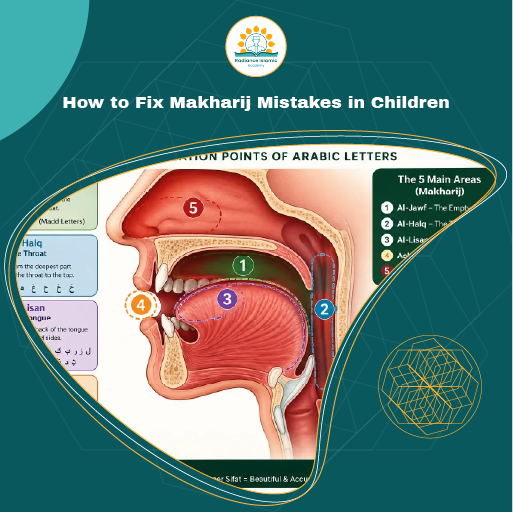
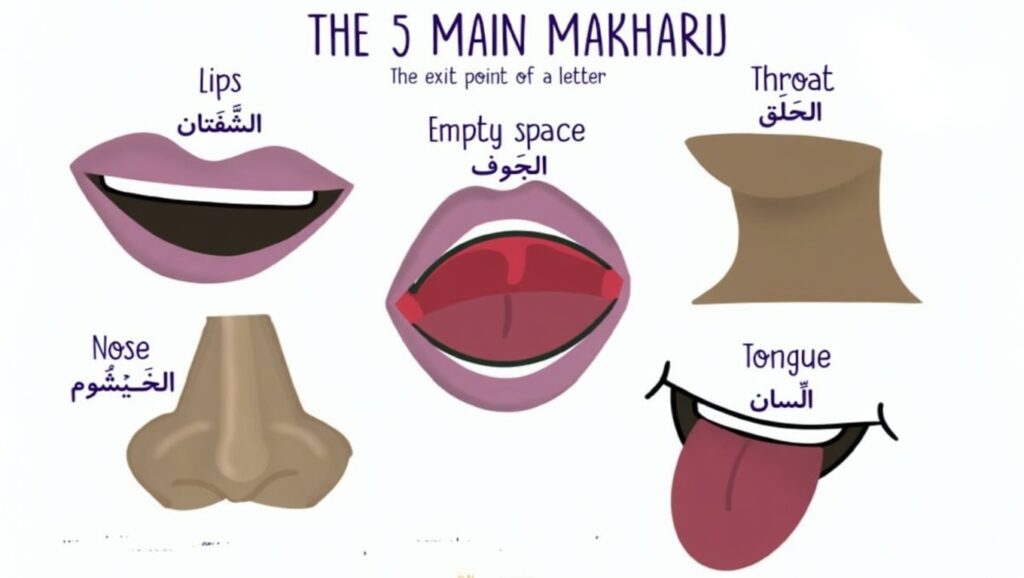
Makharij refers to the articulation points from which Arabic letter sounds are produced.
But children do not need a long technical explanation first.
They need:
- Clear sound modeling
- One correction priority
- Slow repetition
- Practice inside real Quran words
- Application in another ayah
- Follow-up later
Where available, experienced Egyptian female Tajweed teachers and teachers with genuine Al-Azhar education can add valuable Arabic pronunciation and Quranic-learning expertise.
The practical test, however, is whether the teacher can help the child hear, reproduce, and apply the corrected sound.
For the full parent roadmap, Online Tajweed Classes for Kids explains Tajweed readiness, class formats, teacher fit, Hifz connection, and trial decisions.
This article focuses only on how to fix Makharij mistakes in children without overwhelming them.
Quick Answer: How to Fix Makharij Mistakes in Children
To fix Makharij mistakes in children, start with one repeated sound rather than correcting everything at once.
Use this sequence:
- Identify the exact sound problem.
- Model the correct sound clearly.
- Let the child repeat it slowly.
- Place the sound inside a Quran word.
- Test it in another word or ayah.
- Review the same sound later.
The goal is not to make the child memorize every articulation point immediately.
The goal is to help one sound become more accurate and more stable during real Quran recitation.
What Do Makharij Mistakes Look Like in Children?
| What Parents Hear | What It May Suggest |
|---|---|
| Two letters sound too similar | Articulation may be unclear |
| One letter sounds too heavy | Sound production may need adjustment |
| One letter sounds too light | The child may not be producing it accurately |
| Sound changes across different words | Correction is not stable |
| Child succeeds once but loses it later | Transfer is weak |
The important issue is the repeated pattern.
One occasional pronunciation mistake does not always require intensive Makharij work.
Makharij Mistakes vs Quran Reading Mistakes
These are not the same problem.
| What the Child Does | Likely Need |
|---|---|
| Cannot recognize letters | Quran reading foundations |
| Guesses simple words | Decoding practice |
| Reads the word but produces one sound inaccurately | Makharij correction |
| Repeats the same sound across many words | Focused pronunciation work |
| Applies correction in one word only | Transfer practice |
Use this rule:
Cannot decode the word → reading support first.
Can read the word but produces the sound incorrectly → Makharij correction may be needed.
For broader diagnosis, continue with Does Your Child Need Tajweed Lessons? 7 Signs Parents Should Notice.
How to Fix Makharij Mistakes in Children Step by Step
Use one sound at a time:
Child recites
↓
Teacher identifies one sound problem
↓
Teacher models the correct sound
↓
Child repeats slowly
↓
Teacher places the sound inside a Quran word
↓
Child applies it in another word or ayah
↓
Teacher reviews it later
The most important stage is transfer.
Repeating the teacher’s exact example shows imitation.
Applying the sound correctly in another Quran word shows that the skill is beginning to develop.
Fix One Makharij Sound Before Adding Another
| Weak Correction | Better Makharij Correction |
|---|---|
| Correct many sounds at once | Choose one repeated sound |
| Keep saying “wrong” | Model the sound clearly |
| Practise isolated letters only | Return the sound to Quran words |
| Move on after one success | Check another example |
| Forget old mistakes | Review the same sound later |
One well-corrected sound is more useful than several vague corrections.
The teacher may hear many problems.
That does not mean all of them should become the child’s focus today.
Use the Makharij Correction Transfer Test
| Question | Good Sign |
|---|---|
| Can the child hear the difference? | Listening is improving |
| Can the child repeat the sound slowly? | Basic control is developing |
| Can the child use it in one Quran word? | Application has started |
| Can the child use it in another ayah? | Transfer is beginning |
| Is the sound clearer next lesson? | Correction is stabilizing |
| Are fewer reminders needed? | Independence is growing |
If several answers are no, do not rush to another sound.
Keep the current Makharij priority until the child can use it more consistently.
Why Makharij Mistakes Keep Coming Back
A corrected sound may return to its old form because:
- The child cannot hear the difference clearly
- The sound is unfamiliar in the child’s home language
- Recitation becomes rushed
- Too many sounds were corrected at once
- Home practice does not match the teacher’s correction
- The mistake is already part of memorized Quran
- The teacher did not review the sound later
This section should remain brief.
For the full diagnosis, continue with Why Kids Repeat the Same Quran Pronunciation Mistakes.
How a Tajweed Teacher Should Model Quran Sounds for Children
A strong teacher should make the target sound easy to hear.
The teacher may:
- Say the sound slowly
- Let the child listen before repeating
- Compare the current sound with the target sound
- Use one short Quran word
- Repeat calmly
- Return the sound to real recitation
- Review it later
For families seeking strong Arabic pronunciation, experienced Egyptian female teachers can offer valuable native sound modeling.
Where genuine Al-Azhar education or training is available, that can add an additional trust signal.
But teacher background must become effective teaching.
The child still needs to hear, understand, retry, and apply the sound.
How Parents Can Support Makharij Practice at Home
Parents should reinforce the teacher’s correction rather than create their own technical Tajweed lesson.
A simple review may include:
- One sound
- One Quran word
- One short ayah
- One teacher-given task
- One note for the next lesson
Avoid introducing new articulation rules independently.
Instead of:
“Your pronunciation is wrong.”
Use:
“Let’s try the sound the way your teacher showed you.”
For the full home routine, continue with A 15-Minute Daily Tajweed Practice Routine for Kids.
Real Parent Case Study: Yusuf, a 5-Year-Old Learner in the UK
One real example involved Yusuf, a 5-year-old learner in the UK, who began Quran lessons with almost no Quran reading foundation.
At the beginning, he needed basic reading support, regular practice, and pronunciation correction. Some letter sounds were not clear, and progress depended heavily on consistency at home.
His father supported him strongly between classes, helped him stay consistent with homework, and followed the teacher’s guidance.
His teacher worked patiently on reading foundations and pronunciation correction instead of rushing him into advanced material.
After around one year, Yusuf reached a much stronger age-appropriate Quran reading and recitation level. He still needed continued practice, but his progress showed an important lesson:
Makharij and pronunciation correction work best when the child starts at the right level.
The teacher should not rush advanced rules before the child is ready.
The parent’s support at home should reinforce the teacher’s focus.
This case does not mean every child will progress at the same speed.
It shows why Makharij correction needs patience, teacher guidance, repetition, and steady home support.
Yusuf’s case shows why Makharij correction works best when the child starts at the right reading level, receives focused sound modeling, practises the same correction consistently, and receives patient support at home.
Makharij Correction for Kids During Hifz
A sound mistake may become harder to change when it is repeated inside memorized Quran.
Parents should check:
- Does the sound error appear in memorized surahs?
- Is the teacher correcting it during revision?
- Is the child repeating it automatically?
- Is new memorization moving faster than correction?
This does not mean Hifz must stop.
It means pronunciation correction should be part of revision.
Parents building a wider memorization plan can review Complete Guide to Quran Memorization for Kids.
For the deeper timing decision, continue with Tajweed Before Hifz or During Hifz: Which Is Better for Kids?

The Makharij Correction Priority Rule
| Priority Question | If Yes |
|---|---|
| Does the mistake strongly distort the sound? | Correct early |
| Does it repeat across many words? | Make it a priority |
| Does it appear in memorized surahs? | Correct during revision |
| Does it cause two letters to sound alike? | Focus on sound distinction |
| Does correction create fear? | Review teacher style |
| Is the mistake occasional and self-corrected? | Monitor without overload |
Not every pronunciation issue needs equal attention.
Prioritize the mistake that most affects accurate recitation.
When to Change the Makharij Correction Method
Change the correction method when:
- The same sound remains unchanged for several weeks
- The child can repeat but never transfer it
- Practice stays isolated from Quran words
- The child does not understand what to change
- Home practice is unclear
- Correction is creating increasing frustration
Use this rule:
Sound is improving
+
Child needs fewer reminders
=
Keep the current method

Sound stays unchanged
+
Same method has been repeated for weeks
=
Change the correction method
Do not automatically respond by increasing practice time.
Sometimes the method—not the effort—needs adjustment.
How Radiance Islamic Academy Helps Fix Makharij Mistakes in Children
At Radiance Islamic Academy, Makharij correction should begin with the child’s current Quran reading level, pronunciation needs, confidence, and first sound priority.
During an assessment or trial, the teacher can check:
- Quran reading level
- Repeated Makharij mistakes
- Pronunciation needs
- Tajweed readiness
- Hifz-related pronunciation errors
- Child response to correction
- First measurable sound goal
Parents should then receive guidance explaining:
- Which Makharij mistake should be corrected first
- Why that sound has priority
- How the sound will be modeled
- What should be practised at home
- Which mistakes can wait
- How transfer will be checked
- When progress will be reviewed
Where available, parents may also ask about Egyptian female Tajweed teachers and teachers with genuine Al-Azhar education or training.
These backgrounds can support accurate Arabic sound modeling when combined with child-friendly correction and structured follow-up.
Parents can also explore the Quran Tajweed Course, review Plans & Fees, and check the Teachers Page before choosing the next step.
Learn More About Radiance Islamic Academy
Parents can use Radiance Islamic Academy’s official Facebook, Instagram, and WhatsApp channels to review communication, teacher information, learning updates, and enrollment options.
Parents may also ask about:
- Child assessment
- Makharij correction
- Egyptian female Tajweed teachers
- Al-Azhar-trained teachers where applicable
- Trial availability
- Lesson options
These channels provide supporting context.
The final learning decision should still depend on assessment, sound correction quality, teacher fit, child comfort, and visible progress.
Common Mistakes When Fixing Makharij Mistakes in Children
Avoid:
- Correcting many sounds at once
- Practising isolated letters only
- Repeating “wrong” without modeling
- Moving on after one successful repetition
- Ignoring whether the child can hear the difference
- Adding more Hifz while the same sound remains unchecked
- Making the child embarrassed
- Increasing practice without checking the correction method
Makharij correction should make Quran recitation clearer.
Not make the child afraid to try.
Frequently Asked Questions
Makharij mistakes happen when a child produces Quran letter sounds inaccurately because the articulation or sound control is not stable.
Fix one sound at a time. Model it clearly, let the child repeat, apply it inside a Quran word, test it in another ayah, and review it later.
Parents can reinforce the teacher’s latest correction, but technical Makharij correction should usually remain teacher-led.
The sound may be difficult to hear, correction may not have transferred, recitation may be rushed, or the mistake may already be part of memorized Quran.
Review the method when the same sound remains unchanged for several weeks despite focused practice and repeated teacher correction.
Conclusion: Fix One Makharij Sound at a Time
How to fix Makharij mistakes in children begins with focus.
Do not correct every sound at once.
Start with one repeated mistake.
Then:
- Model the sound clearly.
- Let the child repeat calmly.
- Place it inside a Quran word.
- Test it in another ayah.
- Review it later.
- Change the method if the sound remains stuck.
The goal is not technical theory alone.
It is clearer Quran pronunciation that becomes more stable and more independent over time.
Next Step
If you want the full Tajweed learning path, continue with Online Tajweed Classes for Kids.
When a child continues to repeat the same sound after initial correction, continue with Why Kids Repeat the Same Quran Pronunciation Mistakes.
If you want a wider list of Tajweed errors, continue with 9 Common Tajweed Mistakes Kids Make and How to Correct Them.
If you want to identify your child’s first Makharij priority, book a Free Quran Assessment.