


Online Tajweed Classes for Kids: A Parent’s Guide to Better Quran Recitation
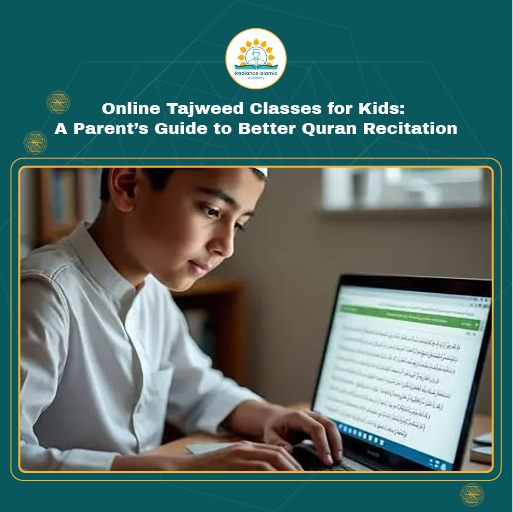
Many parents want their children to recite Quran beautifully, clearly, and correctly.
But when a child repeats the same letter mistake, rushes through words, or memorizes short surahs with unclear pronunciation, parents often wonder whether ordinary Quran reading lessons are enough.
At that point, the question is not only:
“Can my child learn Tajweed online?”
The better question is:
“Can online Tajweed classes for kids help my child recite more accurately without pressure or fear?”
Tajweed for children should not feel heavy, strict, or frightening. A young child does not need to be buried under complex rules from the first lesson. Instead, children need careful listening, gentle correction, repetition, and a teacher who knows how to improve pronunciation while protecting confidence.
For parents still comparing the wider Quran learning journey, The Parent’s Guide to Choosing the Best Online Quran Classes for Kids explains how to evaluate the overall class format, teacher fit, safety, and learning path.
This guide focuses specifically on online Tajweed classes for kids: when Tajweed support may be useful, what lessons should look like, how correction should work, and what parents should check before enrolling.
Quick Answer: What Are Online Tajweed Classes for Kids?
Online Tajweed classes for kids are live Quran lessons that help children improve pronunciation, recitation, letter articulation, and age-appropriate Tajweed application through listening, practice, and teacher correction.
A strong Tajweed class should:
- Match the child’s current Quran level
- Focus on real recitation, not theory alone
- Correct a small number of important mistakes
- Give the child time to try again
- Connect correction to short home practice
- Review whether previous mistakes are improving
- Protect confidence while maintaining accuracy
The goal is not to teach every Tajweed rule quickly.
It is to help the child recite more accurately and apply correction more independently over time.
When Might a Child Need Tajweed Lessons?
Tajweed support may be useful when a child can already read or recite but repeatedly struggles with pronunciation or recitation accuracy.
Parents may notice:
| What Parents Notice | What It May Suggest |
|---|---|
| The same letter mistake returns | Focused sound correction may help |
| The child rushes through words | Recitation control may need support |
| Memorized surahs contain unclear sounds | Tajweed may need to support Hifz |
| Rules are known but not applied | Guided recitation is needed |
| The child avoids reading aloud | Confidence or correction style needs review |
Not every mistake means the child needs a full Tajweed course.
Sometimes the better first step is reading repair or pronunciation support.
For a full diagnostic checklist, continue with Does Your Child Need Tajweed Lessons? 7 Signs Parents Should Notice.
Benefits of Online Tajweed Classes for Kids
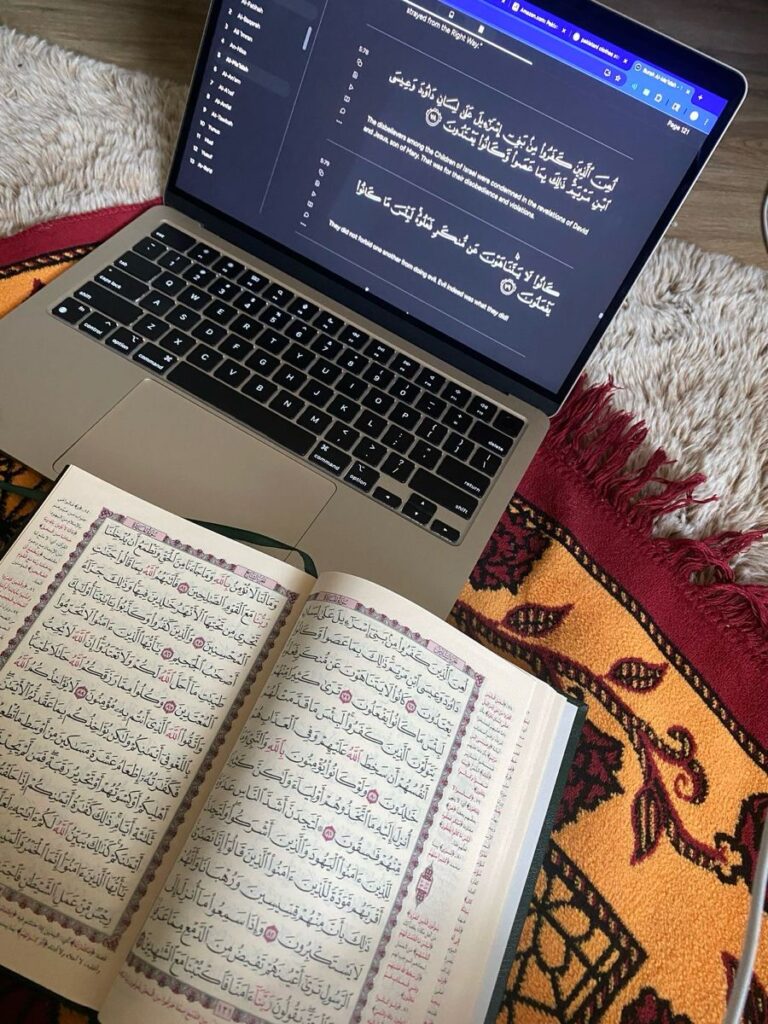
When lessons are live, corrective, and level-matched, Tajweed support can help children:
- Pronounce Quran letters more clearly
- Reduce repeated recitation mistakes
- Slow down and control recitation
- Develop stronger listening habits
- Apply simple Tajweed principles
- Support more accurate memorization
- Read aloud with greater confidence
The benefit should be visible in recitation.
A child does not need to memorize many rule names to show Tajweed progress.
What Should Online Tajweed Lessons for Children Include?
| Lesson Step | What Happens |
|---|---|
| Review | Teacher checks the previous correction |
| Listening | Child hears the correct sound or recitation |
| Recitation | Child reads or repeats |
| Correction | Teacher focuses on one important mistake |
| Application | Child applies it in another word or ayah |
| Practice | One short task is given for home review |
| Follow-up | The correction is checked again later |
A strong lesson creates a correction loop:
Child recites
↓
Teacher identifies one priority
↓
Teacher models the correction
↓
Child tries again
↓
Child applies it in a new example
↓
Teacher reviews it later
The strongest lesson is not the one that covers the most rules.
It is the one where correction begins to transfer into the child’s real recitation.
Tajweed for Kids Should Be Gentle but Accurate
Children should not receive every correction at once.
A strong teacher chooses the mistake that matters most and gives the child time to apply it.
| Strong Correction | Weak Correction |
|---|---|
| Focuses on one priority | Corrects many mistakes at once |
| Models the sound | Only says “wrong” |
| Lets the child retry | Moves forward immediately |
| Checks another example | Corrects one word only |
| Reviews old mistakes | Forgets previous correction |
| Protects confidence | Creates fear of recitation |
Common problems may include letter articulation, Madd, heavy and light sounds, stopping, or applying a known rule inconsistently.
The teacher should diagnose which issue is most important now rather than treating every mistake equally.
What Is the Best Age to Start Tajweed for Kids?
There is no single age for every child.
Basic Tajweed support can begin when the child can listen, repeat, and benefit from gentle correction.
For younger children, this may mean:
- Sound modeling
- Listening
- Slow repetition
- Simple pronunciation habits
Older children may gradually learn:
- More explicit Tajweed rules
- Stronger Makharij correction
- Fluency
- Recitation application
Reading readiness matters more than forcing Tajweed at a particular birthday.
If the child is still struggling with basic letters and vowels, reading foundations may need priority.
For the full age decision, continue with What Is the Best Age to Start Tajweed for Kids?
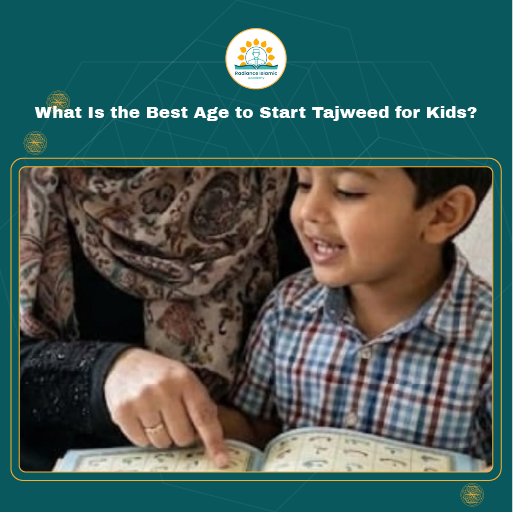
How Tajweed Connects with Quran Memorization
Tajweed and Hifz should support each other.
A child who memorizes incorrect pronunciation may repeat the same mistake every time the portion is reviewed.
However, Tajweed should not stop memorization indefinitely.
The right balance depends on the child:
| Situation | Better Priority |
|---|---|
| Memorizes but repeats sound mistakes | Correct Tajweed during Hifz |
| Basic reading is still weak | Strengthen reading first |
| Old memorization is unstable | Protect revision |
| Recites confidently but inaccurately | Focused pronunciation correction |
For the full decision, continue with Tajweed Before Hifz or During Hifz: Which Is Better for Kids?
Parents building a full memorization path can also review Online Quran Memorization Course for Kids and Complete Guide to Quran Memorization for Kids.
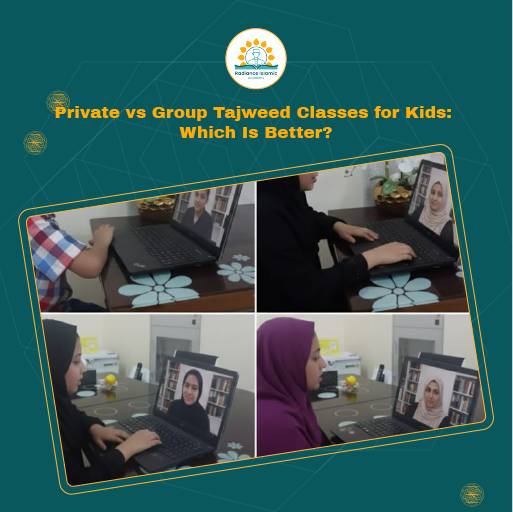
Private vs Group Online Tajweed Classes for Kids
Private Tajweed lessons may provide better value when a child needs:
- Detailed pronunciation correction
- More recitation time
- Hifz support
- A slower pace
- Greater confidence
Small-group Tajweed classes may work well when children are level-matched and each child still receives enough teacher listening time.
For Tajweed, the main question is not simply:
“Private or group?”
It is:
“How much useful recitation and correction time will my child receive?”
For the detailed comparison, continue with Private vs Group Tajweed Classes for Kids: Which Is Better?
What Should Parents Look for in an Online Tajweed Teacher?
A strong Tajweed teacher for children should combine recitation knowledge with child-friendly teaching.
Look for:
- Accurate listening
- Clear pronunciation modeling
- Gentle correction
- Age-appropriate explanations
- Patience with repetition
- Ability to prioritize mistakes
- Short home practice
- Parent communication
The teacher should know Tajweed.
But they should also know how to teach Tajweed to a child.
Parents can review the academy’s Teachers Page to understand available teaching support.
For the broader teacher-selection process, continue with How to Choose the Right Online Quran Teacher for Your Child.
How Much Do Online Tajweed Classes for Kids Cost?
Cost may depend on:
- Private or group format
- Lesson length
- Weekly frequency
- Teacher experience
- Level of individual correction
- Hifz support
Parents should compare the amount of useful teacher listening and correction, not price alone.
A lower-cost class may offer poor value if the child receives little recitation time.
For current options, parents can review Plans & Fees.
For the detailed pricing decision, continue with How Much Do Online Tajweed Classes Cost for Kids?
What Should Parents Check During the First Lesson or Free Trial?
A first lesson or trial should give evidence of the child’s starting point and teacher fit.
Look for:
| Check | What It Should Show |
|---|---|
| Short recitation sample | Current level |
| Pronunciation check | First correction priority |
| Teacher modeling | Correction style |
| Child retry | Ability to apply feedback |
| Parent feedback | What to review |
| Recommendation | Suitable next step |
Parents should ask:
- Did the teacher identify one real issue?
- Was correction calm and specific?
- Did my child participate?
- Was the next step explained?
- Did the session feel diagnostic rather than purely promotional?
For the complete trial checklist, continue with Online Tajweed Classes with a Free Trial: What Parents Should Check.
How to Know Online Tajweed Classes Are Working
Look for gradual evidence:
- Fewer repeated pronunciation mistakes
- Better control of difficult sounds
- Slower, more deliberate recitation
- Greater confidence after correction
- Better application in new ayat
- Fewer teacher prompts
- Better retention of previous correction
The strongest sign is transfer:
Can the child apply a correction outside the exact example the teacher used?
That shows the lesson is becoming a skill rather than simple repetition.
Red Flags in Online Tajweed Classes for Kids
Be cautious when:
- Too much theory is introduced too early
- Correction is harsh or embarrassing
- The child receives little recitation time
- The same mistakes remain for many lessons
- The class moves forward without reviewing correction
- Parents receive no useful feedback
- Lesson length repeatedly exceeds the child’s attention
- The child becomes increasingly afraid to recite
One difficult lesson does not prove poor teaching.
Look for repeated patterns.
Online Tajweed Classes for Kids at Radiance Islamic Academy

Before choosing any academy, parents should be able to understand the learning path, teacher experience, assessment process, class format, communication, and lesson options.
At Radiance Islamic Academy, Tajweed support should begin with the child’s current reading level, pronunciation needs, Tajweed readiness, Hifz connection, schedule, and confidence.
During an assessment or trial, the teacher can check:
- Quran reading level
- Repeated pronunciation mistakes
- Tajweed readiness
- Hifz and revision needs
- Suitable class format
- First measurable correction goal
Parents should then receive a recommendation explaining:
- Where the child should begin
- Whether reading or Tajweed needs priority
- Which correction should come first
- Whether private or group learning may fit
- What should be practised at home
- How progress will be reviewed
Parents can also review the academy’s Courses, Teachers, and Plans & Fees pages, along with official social channels, before making the final decision.
The final choice should depend on assessment, teacher fit, correction quality, child comfort, and measurable progress.
Learn More About Radiance Islamic Academy
Students and parents can visit Radiance Islamic Academy’s official Facebook, Instagram, and WhatsApp channels to review academy communication, updates, and enrollment information.
These channels provide supporting evidence. The final decision should still depend on assessment, teacher fit, correction, safety, policies, transparency, and measurable progress.
Questions to Ask Before Enrolling
Ask:
- How will my child’s recitation be assessed?
- What Tajweed skill will be corrected first?
- How much actual recitation time will my child receive?
- How does the teacher avoid overwhelming children?
- How is Tajweed connected with reading or Hifz?
- What should we practise at home?
- How will progress be reviewed?
Clear, specific answers are a stronger sign than general claims about “excellent Tajweed teaching.”
Online Tajweed Classes for Kids: Final Decision Checklist
Before enrolling, check:
| Decision Area | Good Sign |
|---|---|
| Starting level | Child is assessed before placement |
| Teacher | Tajweed knowledge + child-friendly teaching |
| Recitation time | Child regularly reads and responds |
| Correction | Specific, gentle, and reviewed later |
| Lesson pace | Matches age and attention |
| Hifz connection | Memorization mistakes are not ignored |
| Parent feedback | Home task is clear |
| Progress | Repeated mistakes decrease |
| Child comfort | Child feels safe trying again |
If several areas are weak, adjust the teacher, class format, or learning path before committing.
Frequently Asked Questions
Online Tajweed classes for kids are live Quran lessons where children practise recitation and receive teacher-led pronunciation and Tajweed correction.
A child can begin basic Tajweed support when they can listen, repeat, and benefit from correction. Formal rules can be introduced gradually based on reading readiness.
They can be effective when lessons are live, age-appropriate, correction-focused, and give the child enough recitation time.
Not always. Some children need reading or pronunciation repair first, while others can improve Tajweed alongside memorization.
Private classes may be better when the child needs detailed correction or more teacher listening time. Small groups can also work when students are level-matched and actively corrected.
Conclusion: Are Online Tajweed Classes for Kids Worth It?
Online Tajweed classes for kids can be valuable when they help the child recite more accurately without turning Quran learning into pressure.
A strong class should provide:
- Level-appropriate Tajweed support
- Real recitation time
- Gentle but accurate correction
- A teacher who understands children
- Clear parent feedback
- A connection between Tajweed, reading, and Hifz
- Progress that becomes visible over time
The best Tajweed class is not the one that teaches the most rules.
It is the one that helps the child hear a mistake, correct it, apply the correction again, and return to recitation with confidence.
Continue Your Decision
If your child needs teacher-led correction, review the Teachers Page.
When comparing available lesson formats, review Plans & Fees.
If your child is ready for a structured Tajweed path, explore the Quran Tajweed Course.
If you want to test your child’s level first, book a Free Trial.