


Your child may love reciting Quran but repeat the same sound incorrectly.
Another child may rush through words, shorten a Madd, or memorize a surah with unclear pronunciation.
Parents often notice the mistake but do not know whether to correct it immediately, wait, or ask for more focused Tajweed support.
Common Tajweed mistakes kids make are not always a sign of poor effort.
The important question is:
“Is this an occasional mistake, or is it becoming a repeated recitation habit?”
If you want the full Tajweed learning path first, Online Tajweed Classes for Kids explains readiness, lessons, teacher fit, Hifz connection, and enrollment decisions.
This article focuses only on nine common Tajweed mistakes and how to correct them without overwhelming the child.
Quick Answer: Common Tajweed Mistakes Kids Make
Common Tajweed mistakes kids make include:
- Makharij errors
- Heavy and light letter confusion
- Rushing
- Madd mistakes
- Qalqalah mistakes
- Poor stopping and restarting
- Knowing rules without applying them
- Memorizing pronunciation mistakes
- Fear of correction
The best response is not to correct every mistake at once.
Use this process:
- Identify the repeated mistake.
- Model the correct sound or recitation.
- Let the child try again slowly.
- Apply the correction in another word or ayah.
- Check the same skill later.
The goal is not instant perfection.
It is correction that becomes stable during real recitation.
Common Tajweed Mistakes Kids Make: What Parents Should Notice
| What You Notice | What It May Mean | Better First Response |
|---|---|---|
| Same sound mistake repeats | Makharij may need correction | Isolate one sound |
| Child rushes words | Recitation control is weak | Slow one short passage |
| Madd is inconsistent | Timing needs guidance | Practise one Madd example |
| Rule is known but not applied | Application is weak | Correct during recitation |
| Mistake enters memorized Quran | Hifz needs Tajweed support | Review before adding more |
The concern is not one occasional mistake.
The concern is a mistake that repeats across different words, lessons, or memorized portions.
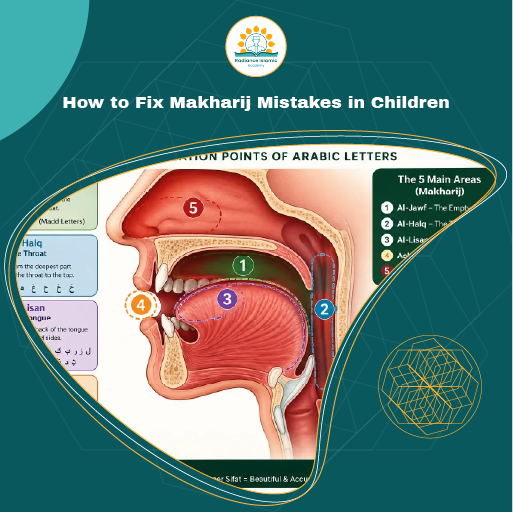
1. Makharij Mistakes in Children
Makharij mistakes happen when a child produces a letter inaccurately even though they recognize the correct letter.
The teacher should:
- Isolate one sound
- Model it clearly
- Let the child repeat slowly
- Return the sound to a Quran word
- Check it in another word or ayah
- Review it later
Use this correction loop:
Child recites
↓
Teacher identifies one sound problem
↓
Teacher models the correction
↓
Child repeats slowly
↓
Child applies it in another Quran word
↓
Teacher checks it later
Do not explain Makharij in depth here.
For the full correction path, continue with How to Fix Makharij Mistakes in Children.
2. Heavy and Light Letter Confusion
Some children recognize the correct letter but make it sound heavier or lighter than it should.
A useful correction is to compare:
- The child’s current sound
- The teacher’s model
- The same sound inside a short Quran word
- A second example to test transfer
Do not keep the correction isolated at letter level.
The child needs to apply it during real recitation.
3. Rushing Through Quran Recitation
Rushing may cause:
- Unclear vowels
- Weak word endings
- Missed elongation
- Poor stopping
- Less accurate pronunciation
The solution is not simply:
“Read slower.”
Use one short passage and ask the child to recite it with control.
A shorter accurate passage is more useful than a long rushed one.
4. Madd Mistakes
Children may shorten, lengthen, or apply Madd inconsistently.
Start with one repeated example.
| Weak Approach | Better Approach |
|---|---|
| Explain many Madd types at once | Teach one clear example |
| Correct many words in one lesson | Focus on one pattern |
| Explain theory only | Model and repeat |
| Move on after one correct attempt | Check the same pattern later |
For younger children, hearing and application may matter more than memorizing technical rule names immediately.
5. Qalqalah Mistakes
Qalqalah may be:
- Missing completely
- Too weak
- Exaggerated
The teacher should model the sound inside a real Quran word and let the child repeat it without forcing the bounce.
The goal is controlled application.
Knowing the rule name is not enough if the child cannot apply it during recitation.
6. Stopping and Starting Mistakes
Children may stop because of breath, rushing, or uncertainty.
Early correction should stay simple.
A teacher can practise one short passage and show:
- Where to pause
- Where to continue
- How to restart
- How to avoid rushing after a pause
Do not turn this section into a full Waqf and Ibtida guide.
Keep it practical and child-focused.
7. Knowing Tajweed Rules but Not Applying Them
A child may know the name of a rule but forget it during real recitation.
This means the problem is application, not lack of theory.
The teacher should ask:
“Can the child apply the rule in a new ayah without being reminded?”
If not, reduce theory and increase guided recitation.
For broader diagnosis, continue with Does Your Child Need Tajweed Lessons? 7 Signs Parents Should Notice.

8. Memorizing Quran with Tajweed Mistakes
Pronunciation mistakes can become harder to change when they are repeated inside memorized surahs.
The solution is not necessarily to stop Hifz.
Instead:
- Protect old revision
- Correct the repeated sound
- Recheck the memorized ayah
- Avoid adding too much new material while the mistake remains unstable
For the wider memorization framework, continue with Complete Guide to Quran Memorization for Kids.
The deeper decision about timing belongs in Tajweed Before Hifz or During Hifz: Which Is Better for Kids?
9. Fear of Correction
Sometimes the child’s biggest obstacle is not a Tajweed rule.
It is fear of being wrong.
Watch for:
- Whispering instead of reciting clearly
- Refusing to read
- Becoming upset after correction
- Giving up quickly
- Avoiding the lesson
A good teacher keeps correction accurate but calm.
The child should feel:
“I can try again.”
Not:
“I always get this wrong.”
The Tajweed Mistake Correction Priority Test
Not every mistake should be corrected first.
Use this order:
| Priority Question | If Yes |
|---|---|
| Does the mistake change or seriously distort the sound? | Correct early |
| Does it repeat in many words? | Make it a priority |
| Is it entering Hifz? | Correct before it becomes habitual |
| Does it prevent another Tajweed skill from improving? | Correct first |
| Is it occasional and self-corrected? | Monitor rather than overload |
This prevents parents and teachers from treating every small mistake as equally urgent.
How to Correct Tajweed Mistakes Without Overwhelming Kids
Use one correction priority at a time.
| Action | Why It Helps |
|---|---|
| Choose one repeated mistake | Keeps attention focused |
| Model it clearly | Shows what should change |
| Let the child retry | Builds control |
| Apply it in another example | Tests transfer |
| Review it later | Builds stability |
| Praise effort and correction | Protects confidence |
Do not turn every recitation into a list of errors.
Correction should remain focused enough for the child to remember what to change.
How Radiance Islamic Academy Helps Prioritize Tajweed Correction

Once parents notice several Tajweed mistakes, the practical question becomes:
“Which mistake should be corrected first?”
At Radiance Islamic Academy, an assessment or trial can check:
- Repeated pronunciation mistakes
- Makharij needs
- Madd or stopping problems
- Tajweed application
- Hifz-related errors
- Child confidence during correction
- First measurable correction goal
Parents should then receive a recommendation explaining:
- Which mistake has priority
- Why it should be corrected first
- What should be practised at home
- Which mistakes can wait
- How progress will be checked later
The goal is not to correct everything at once.
It is to build a clear correction sequence.
Learn More About Radiance Islamic Academy
Parents can visit Radiance Islamic Academy’s official Facebook, Instagram, and WhatsApp channels to review communication, updates, and enrollment information.
These channels provide supporting context.
The final learning decision should still depend on assessment, correction quality, teacher fit, child comfort, and visible progress.
Frequently Asked Questions
Common mistakes include Makharij errors, heavy and light letter confusion, rushing, Madd, Qalqalah, stopping, weak rule application, Hifz pronunciation errors, and fear of correction.
No.
Correct the most repeated or important mistake first and review whether the child can apply the correction later.
Yes
Repeated pronunciation mistakes may become part of memorized recitation if they are not corrected and reviewed.
Use clear modeling, short practice, one correction priority, application in a new example, and later review.
Teacher support is useful when the same mistake keeps returning, affects multiple words or memorized portions, or does not improve through ordinary reading practice.
Conclusion: Correct the Pattern, Not Every Mistake at Once
Common Tajweed mistakes kids make should not cause panic.
Occasional mistakes are part of learning.
Repeated patterns deserve attention.
The best approach is:
- Identify the mistake that matters most.
- Model the correction clearly.
- Let the child apply it in a new example.
- Check whether it returns later.
- Move to the next priority only when needed.
The goal is not perfect recitation after one lesson.
It is helping the child make fewer repeated mistakes while remaining confident enough to keep reciting.
Next Step
If you want the full Tajweed learning path, continue with Online Tajweed Classes for Kids.
If Makharij is the main issue, continue with How to Fix Makharij Mistakes in Children.
you are unsure whether the mistakes require Tajweed lessons, continue with Does Your Child Need Tajweed Lessons? 7 Signs Parents Should Notice.