



A child may read Quran with effort but repeat the same pronunciation mistake.
Another may know a Tajweed rule but forget it during real recitation.
Another may understand the correction but become nervous when asked to try again.
In these situations, teacher fit matters.
Choosing an online Tajweed teacher for kids is not only about finding someone who knows Tajweed.
The teacher should be able to hear the child’s real mistake, explain it simply, correct it gently, and check whether the correction transfers into later recitation.
If you are still deciding whether your child needs Tajweed support at all, Online Tajweed Classes for Kids explains the wider learning path.
This article focuses only on choosing the right Tajweed teacher for your child.
Quick Answer: How to Choose an Online Tajweed Teacher for Kids
Choose an online Tajweed teacher who can:
- Listen carefully to real recitation
- Identify the main pronunciation or Tajweed problem
- Correct one priority at a time
- Model sounds clearly
- Help the child apply correction in a new ayah
- Teach at an age-appropriate pace
- Protect confidence while maintaining accuracy
- Give parents clear feedback
- Review whether previous mistakes are improving
Do not choose only by qualification, price, availability, or friendliness.
Choose the teacher who can turn Tajweed knowledge into correction your child can actually apply.
What Makes a Tajweed Teacher for Kids Different?
| Child’s Need | What the Tajweed Teacher Should Do |
|---|---|
| Repeated sound mistake | Model and correct the sound clearly |
| Makharij confusion | Explain and demonstrate articulation |
| Rushed recitation | Slow the pace and improve control |
| Rule not applied | Check it during real recitation |
| Hifz pronunciation error | Correct it before it becomes habitual |
| Low confidence | Use calm, child-friendly correction |
A general Quran teacher may support reading, revision, or memorization.
A Tajweed teacher needs to hear small recitation errors and decide which one matters most now.
The lesson should remain practical:
recitation, correction, repetition, and application.
A Strong Tajweed Teacher Can Correct Makharij in Context
A child may recognize the correct letter but still produce the sound inaccurately.
A good teacher should:
- Identify the exact sound problem.
- Model the correct articulation.
- Let the child repeat slowly.
- Return the sound to the Quranic word.
- Check it in a different word or ayah.
- Review it again later.
Use this loop:
Child recites
↓
Teacher identifies one sound problem
↓
Teacher models the correction
↓
Child repeats
↓
Child applies it in another example
↓
Teacher reviews it later
The key is transfer.
If the child can only copy one teacher example, the skill may not yet be stable.
For deeper Makharij correction, continue with How to Fix Makharij Mistakes in Children.
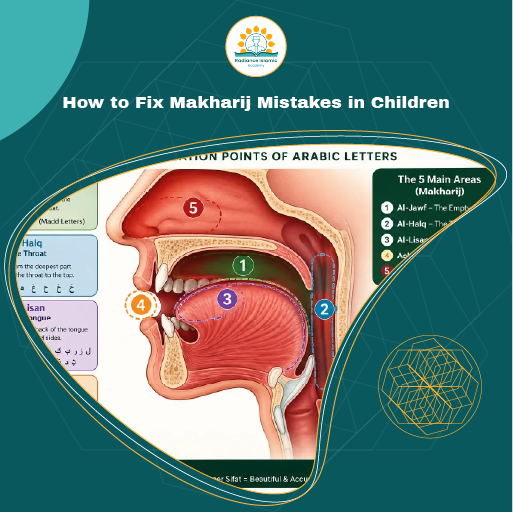
A Tajweed Teacher Should Correct Gently but Accurately
| Weak Correction | Better Tajweed Correction |
|---|---|
| “Wrong, repeat.” | Models the sound and lets the child retry |
| Corrects many mistakes at once | Chooses one main priority |
| Moves on immediately | Rechecks the same skill |
| Embarrasses the child | Gives time to try again calmly |
| Explains too much theory | Teaches through real recitation |
Gentle correction does not mean ignoring mistakes.
It means correcting in a way the child can understand, repeat, and remember.
Match the Tajweed Teacher to Your Child’s Main Goal
| Child’s Main Goal | Teacher Strength to Look For |
|---|---|
| Better pronunciation | Sound modeling and Makharij correction |
| Slower recitation | Pacing and recitation control |
| Applying Tajweed rules | Guided correction during recitation |
| Hifz support | Revision-aware pronunciation correction |
| Low confidence | Gentle child-friendly teaching |
| Advanced recitation | Stronger rule application and fluency work |
A teacher may be excellent for general Quran reading but not the best fit for detailed Tajweed correction.
Choose based on the child’s current need, not only the teacher’s general title.
What Qualifications Matter for a Tajweed Teacher?
Relevant Tajweed knowledge matters.
But parents should also check whether the teacher can use that knowledge with a child.
Ask:
- Can the teacher correct during real recitation?
- Can they explain Makharij simply?
- Can they prioritize mistakes?
- Can they teach without overwhelming the child?
- Can they check whether correction improves later?
The question is not only:
“Does this teacher know Tajweed?”
It is:
“Can this teacher help my child apply Tajweed during real recitation?”
Does Your Child Need a Private or Group Tajweed Teacher?
Private support may be better when the child needs:
- Detailed pronunciation correction
- More teacher listening time
- Hifz-related correction
- A slower pace
- Confidence support
Small-group Tajweed lessons may work when students are level-matched and every child receives enough real recitation time.
For Tajweed, the important question is:
“How much useful listening and correction time will my child receive?”
For the full comparison, continue with Private vs Group Tajweed Classes for Kids: Which Is Better?

What to Watch During a Tajweed Trial Lesson
| Trial Check | Strong Sign |
|---|---|
| Child recites | Lesson is active |
| Teacher identifies one real mistake | Correction has direction |
| Correction is calm and specific | Child can try again |
| Teacher checks another example | Transfer is tested |
| Parent receives one practice task | Home review is clear |
| Next step is explained | Learning path has direction |
A trial should reveal both teacher fit and correction quality.
Do not judge only by friendliness.
For the full Tajweed trial checklist, continue with Online Tajweed Classes with a Free Trial: What Parents Should Check.

The Three-Lesson Tajweed Teacher Fit Test
Do not judge long-term teacher fit from one friendly trial.
After the first three lessons, ask:
| Question | Good Sign |
|---|---|
| Has the teacher identified the main repeated mistake? | Correction has focus |
| Is the child applying correction in new examples? | Learning is transferring |
| Are fewer reminders needed? | The skill is stabilizing |
| Does the teacher remember previous mistakes? | Follow-up is consistent |
| Is home practice specific? | Parent support is manageable |
| Is the child still willing to recite? | Confidence is protected |
| Has the teacher adjusted anything when needed? | Teaching is responsive |
If lessons continue but the same mistake is handled the same way without improvement, teacher fit should be reviewed.
Questions Parents Should Ask Before Choosing a Tajweed Teacher
Ask:
- What recitation problem do you notice first?
- Does my child need reading support before Tajweed?
- How do you correct repeated Makharij mistakes?
- How do you check whether correction transfers?
- How do you prevent children from feeling overwhelmed?
- How does Tajweed support Hifz when needed?
- What should we practise at home?
- When will teacher fit and progress be reviewed?
Clear answers should describe a teaching process.
General promises are not enough.
How Radiance Islamic Academy Helps Match Children with Tajweed Teachers

At Radiance Islamic Academy, teacher matching should begin with the child’s current reading level, pronunciation needs, Tajweed readiness, confidence, Hifz connection, and schedule.
During an assessment or trial, the teacher can check:
- Quran reading level
- Repeated pronunciation mistakes
- Makharij needs
- Tajweed application
- Hifz-related errors
- Child response to correction
- First measurable correction goal
Parents should then receive a recommendation explaining:
- Whether Tajweed is appropriate now
- Which correction should come first
- What teacher experience is most relevant
- What practice should happen at home
- How progress will be reviewed
The goal is to match the child with the teaching support needed for the actual recitation problem.
Learn More About Radiance Islamic Academy
Parents can visit Radiance Islamic Academy’s official Facebook, Instagram, and WhatsApp channels to review communication, updates, and enrollment information.
These channels provide supporting context.
The final teacher decision should depend on assessment, Tajweed expertise, correction quality, child comfort, and visible progress.
Common Mistakes When Choosing an Online Tajweed Teacher
Avoid these mistakes:
- Choosing only by availability
- Choosing only by price
- Assuming every Quran teacher specializes in Tajweed
- Checking qualifications but ignoring teaching skill
- Accepting vague correction
- Choosing a teacher who overwhelms the child
- Ignoring whether correction transfers
- Failing to review teacher fit after several lessons
The right teacher should make correction increasingly easier for the child to apply independently.
Frequently Asked Questions
Choose a teacher who can identify your child’s real recitation problem, correct it gently, check application in new examples, and review progress over time.
The teacher should prioritize the mistake that most affects recitation, such as repeated Makharij errors, unclear pronunciation, rushing, or poor rule application.
Relevant Tajweed knowledge is important, but the teacher must also know how to explain, correct, and work effectively with children.
Private support may help when the child needs detailed pronunciation correction or more listening time. Small groups can also work when children are level-matched and actively corrected.
Look for fewer repeated mistakes, better application in new ayat, fewer teacher prompts, clearer home practice, and a child who remains comfortable reciting.
Conclusion: Choose the Teacher Who Makes Correction Transfer
The right online Tajweed teacher for kids should do more than explain rules.
The teacher should:
- Hear the real recitation problem
- Choose the right correction priority
- Model the sound clearly
- Let the child try again
- Check the correction in a new example
- Review it later
- Protect confidence while maintaining accuracy
The strongest sign of teacher quality is transfer.
The child should gradually move from copying the teacher’s correction to applying it more independently during Quran recitation.
Next Step
If you want the full Tajweed learning path, continue with Online Tajweed Classes for Kids.
If Makharij is the main problem, continue with How to Fix Makharij Mistakes in Children.
you need to compare lesson formats, continue with Private vs Group Tajweed Classes for Kids: Which Is Better?