


Introduction:
Every evening, the moon quietly changes. Most people never notice. Yet for Muslims, that small crescent has guided worship, history, and family life for more than fourteen centuries. Indeed, time is one of Allah’s greatest gifts. Today, modern life in the West moves very fast. Consequently, we often measure our days only by financial quarters, secular deadlines, and school terms. However, Islam introduces a completely different way to experience our days. To truly understand our identity, we must view our time through a complete spiritual circle.
In fact, this guide works as a central map for your family. It connects directly with our deep look into how the Meaning of Hijrah offers a fresh start. Furthermore, it aligns with our exploration of how What Is Muharram opens the year. It also ties beautifully into the lessons of rescue in What Is the Day of Ashura?, and the peaceful limits defined in The Four Sacred Months in Islam. Therefore, the Hijri calendar is not just a tool to count days. Instead, it is a spiritual landscape. It pulls us out of worldly distractions, and it connects our households back to Allah.
How Does the Islamic Calendar Work?
🎯 Featured Snippet: What is the Islamic Calendar?
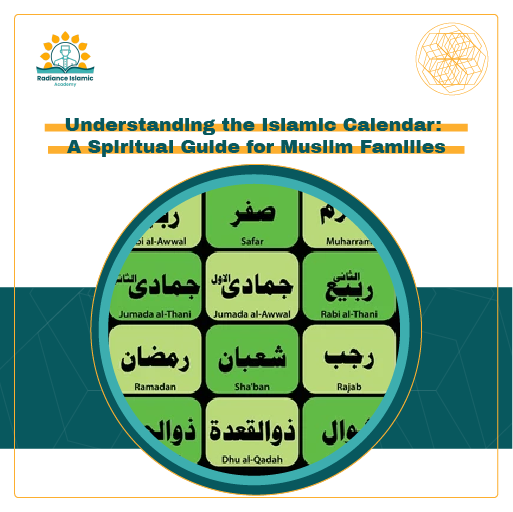
The Islamic calendar is a lunar calendar consisting of 12 months and 354–355 days. It begins with the Hijrah of Prophet Muhammad ﷺ in 622 CE and determines the timing of Islamic worship such as Ramadan, Hajj, and Muharram.
For those striving to understand the heartbeat of our Deen, learning how to track our lives through this sacred framework is an essential milestone. Ultimately, it provides the canvas for a consistent daily routine that protects our souls and our households.
2. The Divine Design of the Lunar Year
Why Does Islam Use a Lunar System?
The choice of the moon is a beautiful mercy from Allah. For example, a solar calendar requires complex mathematical calculations. It needs advanced instruments to maintain accuracy over centuries. In contrast, the lunar calendar is visible and democratic. It is entirely accessible to every human being. This is true whether you are a modern student in London or a traveler in the desert.
To understand the practical differences, look at how the two systems manage our reality:
| Feature | Gregorian Calendar | Islamic Calendar |
| System Type | Solar | Lunar |
| Year Length | 365 Days | 354 Days |
| Seasons | Fixed Seasons | Rotates Through Seasons |
| Primary Use | Civil Life | Worship |
Moreover, our calendar moves backward through the solar seasons. This specific rotation prevents our spiritual lives from becoming repetitive. For instance, we fast Ramadan in the long days of summer. Then, years later, we fast in the short days of winter. Consequently, no single region carries a permanent hardship. Every climate becomes a witness to our devotion.
Restoring Time to Its Pure Form
Before Islam, the pagan Arabs used a flawed system called Nasi’. Sometimes, a sacred month interfered with their political goals or trade caravans. Therefore, their leaders would arbitrarily add an extra month to the year. They did this to delay the peace. This human meddling stripped time of its spiritual sanctity.
However, during the Farewell Pilgrimage, Prophet Muhammad ﷺ changed this. He declared that time had finally returned to its natural state. Human hands could no longer alter what was divine. This restored trust in time itself. Muslims no longer followed calendars shaped by politics or commerce, but by revelation. Today, this restoration establishes a clear baseline for parents learning How to Build an Islamic Home Environment. It shows us that our homes must be governed by divine boundaries. We must not modify our faith to fit material pressures.
3. Mapping the Sacred Journey of the Months
The Spiritual Geography of the Twelve Months
| Hijri Month | Core Identity | Spiritual Focus |
| 1. Muharram | Sacred Month | A quiet reset and the historical victory of Ashura |
| 9. Ramadan | The Month of Quran | Mandatory fasting, internal purification, and night prayers |
| 12. Dhul-Hijjah | Month of Pilgrimage | The ultimate submission of Hajj and family sacrifice |
Weaving the Calendar into Modern Childhood
For children growing up in Western societies, the solar calendar is default. They track their lives by secular winter breaks and summer holidays. Therefore, when we teach them about the Islamic calendar, we must make it an interactive experience.
Try a playful experiment at home. Ask your child: “When do you think Ramadan will come next year?” Then, look at a calendar together. Show them how the month arrives roughly 11 days earlier each year. This visual shift captures their imagination immediately.
                    [ Activating Sacred Time at Home ]

   +--------------------+    +--------------------+    +--------------------+
   | Step outside to    |    | Cross off days on  |    | Discuss stories    |
   | sight the Crescent |--->| a physical Hijri   |--->| of the Prophets    |
   | Moon together      |    | calendar at home   |    | tied to that month |
   +--------------------+    +--------------------+    +--------------------+
Instead of a dry list, try creating a physical calendar space in the living room. This space helps children visualize the journey. Furthermore, it becomes a lasting foundation for parents aiming to master How to Raise Confident Muslim Children. When a child sees a sacred month approaching, they learn to value their identity naturally. They realize they belong to a global community that moves to a higher spiritual rhythm.
4. The Interconnected Flow of History and Knowledge
How Sacrifices Shape Our Days
The historical milestones of our faith are not scattered events. Instead, they form a continuous narrative funnel. The Hijri calendar serves as the perfect map to see how these timeline blocks intersect:
                         [ The Timeline of Sacred Time ]

         Hijrah ----> Muharram ----> Ashura ----> Ramadan ----> Hajj
Every single year, our children are exposed to these profound layers of meaning. When they learn the history of our calendar, they naturally become more receptive to comprehensive Islamic Studies for Kids. They begin to see that our calendar does not celebrate empires or political revolutions. Instead, it honors regular human beings who sacrificed comfort out of profound love for Allah.
As these historical narratives take root, a beautiful change happens. Many families find that their children naturally develop a deeper curiosity about the words of revelation. This organic curiosity is the ideal window to help them Learn Quran. It transforms historical inspiration into a daily, active relationship with the Book of Allah.
To build consistency, parents often look for a structured, reliable environment to Learn Quran Online from home. Whether your child is taking their very first steps to look at Arabic letters, or you are planning a dedicated journey of long-term Quran Memorization, starting at the beginning of the Hijri year adds a layer of deep intention.
Moreover, for advanced students who show readiness, entering a structured Hifz circle can turn this seasonal awareness into a permanent, lifelong protection for their hearts.
5. Direct Answers to Common Questions
Answer: The Islamic calendar relies entirely on the lunar cycle, which lasts about 354 days. In contrast, the Gregorian calendar relies on the solar cycle of 365 days. Because of this 11-day difference, the Hijri calendar moves backward through the solar year annually.
Answer: It appears to change because it is shorter than the Western solar year. The moon cycle completes 12 months in 354 days. Since the solar year takes 365 days, the Hijri calendar slips backward by 11 days every single year. Therefore, Ramadan and Hajj rotate through all seasons over a 33-year block.
Answer: The calendar was officially established during the caliphate of Umar ibn al-Khattab رضي الله عنه. This occurred approximately 17 years after the migration. The companions agreed to use the year of the Hijrah as the definitive anchor for tracking Islamic history.
Answer: The four sacred months are Muharram, Rajab, Dhul-Qi’dah, and Dhul-Hijjah. During these periods, fighting is strictly forbidden. Furthermore, the spiritual weight of both good deeds and wrong actions is significantly amplified.
Answer: A new month begins with the physical confirmation of the new crescent moon (Hilal). This sighting happens after sunset on the 29th day of the current month. However, if the moon is not visible due to clouds, the month automatically completes as 30 days.
Conclusion: Walking Through Time with Intention
The Islamic calendar is a merciful remedy for the modern soul. It ensures that we are regularly pulled back into a divine sanctuary. This remains true no matter how heavy the material pressures of our careers or schools become. It reminds us that true success is not measured by a secular fiscal year. Instead, it is measured by our continuous growth, our internal renewal, and our proximity to Allah.
As you close this page, look at the moon tonight with a soft, reflective heart. Remember that every crescent is an invitation from your Creator to start fresh. Long after we forget the dates on our digital calendars, our hearts will continue to remember the rhythm of the moon that Allah chose for this Ummah. Introduce these gentle cycles to your household. Track the days with sincere intentions, and let the sacred rhythm of the Hijri calendar shape your family’s journey toward lasting peace.
📚 Continue Your Journey
To fully explore how this divine architecture of time guides our worship and protects our households, dive into these next essential chapters:
- The Four Sacred Months in Islam – Learn how to implement the divine boundaries of these special months within your daily home atmosphere.
- What Is the Day of Ashura? – Explore the historic narrative of salvation and mercy that anchors the very beginning of our calendar year.
- How to Build an Islamic Home Environment – Practical steps to realign your physical household routines with the sacred rhythm of the Hijri cycles.