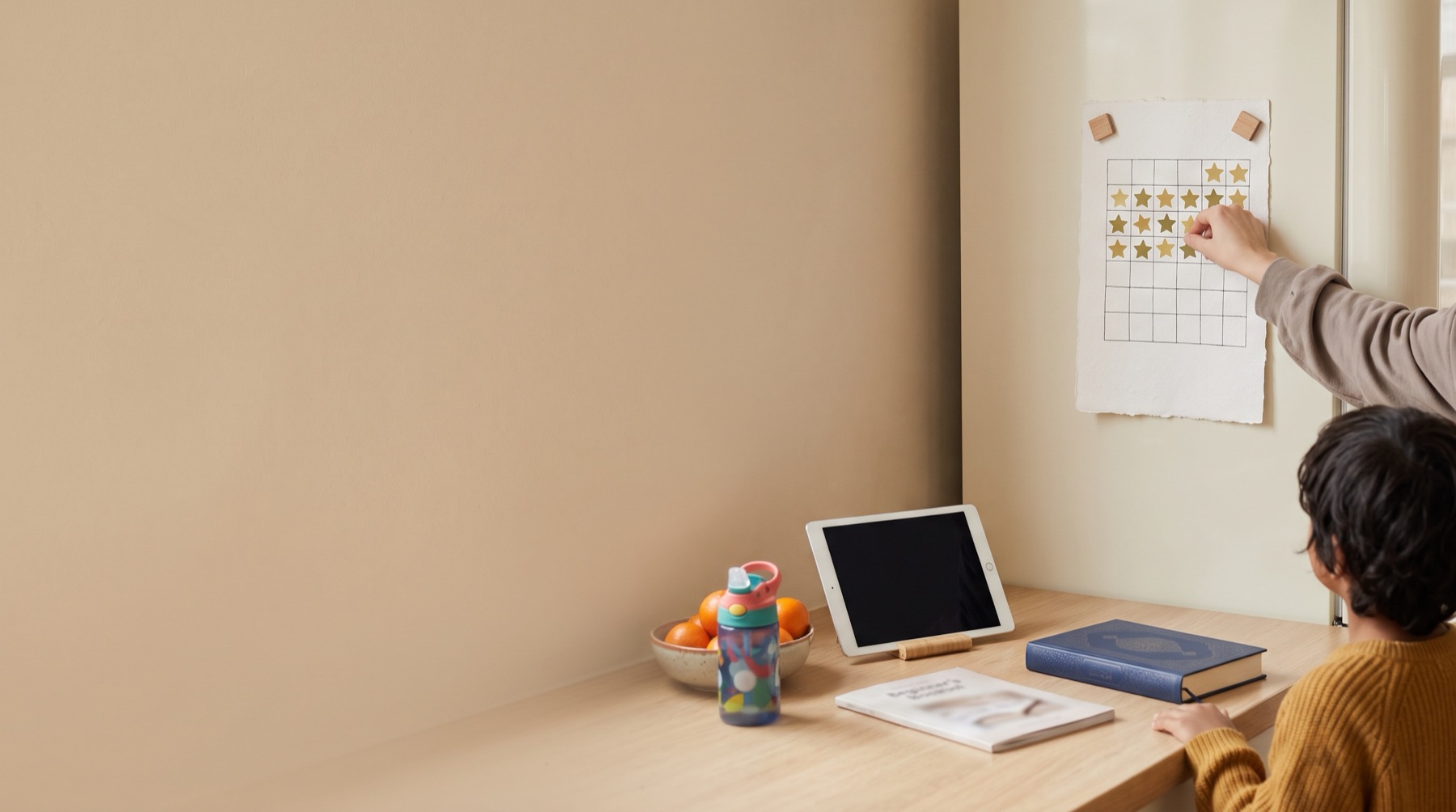

Little and often beats long and rare
If you want your child to keep learning the Qur’an, the most useful thing you can protect is not the length of each lesson. It is the rhythm. Two shorter lessons that happen every week will usually take a child further than one long lesson that keeps getting cancelled.
Children learn the Qur’an through the ear and the tongue: hearing a sound, saying it, being corrected and saying it again. That needs repetition spread over time. When lessons are regular, each one picks up where the last left off. When there are long gaps, much of the next lesson goes on finding the thread again.
Regular lessons also do something quieter. A child who knows that Tuesday and Thursday are Qur’an days stops asking whether there is a lesson today. It simply becomes part of the week, like school or football.
Fixed times on your family’s clock
Consistency starts with a time that really fits your home. A slot that clashes with homework, dinner or a sibling’s activity will be the first thing dropped when the week gets busy.
- Pick a time when your child is fresh. For some children that is straight after school with a snack; for others it is after a rest, or on a weekend morning.
- Keep it the same each week. A fixed slot is easier to remember and harder to push aside.
- Think about the whole family. If you have more than one child learning, lessons next to each other can make the evening simpler.
At Radiance, lesson times are set on your family’s clock, wherever you live, so the time on the timetable is the time in your kitchen.
The same teacher, week after week
Children settle with people they know. A teacher who sees your child every week learns how they think, which letters they find hard, what makes them laugh and when they are tired. Lessons start faster because nothing needs explaining again.
That familiarity matters most on the harder days. A child is far more likely to log on when it is “my teacher” waiting, not a stranger. With the same teacher every week and a written report after every lesson, you also know where things stand without having to ask.
School terms, holidays, Ramadan and travel
A year has its own rhythm, and the Qur’an can travel with it rather than stopping every time the calendar changes.
- School terms. When exams or a new timetable arrive, move the lesson time if you need to, rather than pausing altogether.
- Holidays. Lessons are online, so they can carry on from a grandparent’s house or a holiday flat. A quiet corner and an internet connection are enough, on a computer, tablet or phone.
- Ramadan. Ramadan often brings children closer to the Qur’an. Days and evenings change shape, so it may help to move the lesson to a time that suits the new routine.
- Travel. If you cross time zones, check when the lesson falls in local time and adjust if it lands at an awkward hour.
When a lesson has to be missed
Illness, a family event or a late flight: some lessons will be missed, and that is normal. What matters is that one missed lesson doesn’t quietly become three.
If you know your child can’t make a lesson, tell us at least an hour before and it is rescheduled. Moving a lesson keeps the thread unbroken; simply skipping it often leaves a gap that is harder to close.
If you can, keep a little practice going on the missed day: listening to the surah (chapter of the Qur’an) your child is learning, or reading the lines the teacher last set. It keeps the sounds fresh until the next lesson.
Getting back on track after a break
Sometimes a longer break can’t be avoided: an illness, a move, a hard term. Coming back is easier than parents fear, as long as you don’t try to make up for everything in one go.
Start with revision
Let the teacher hear what your child remembers before anything new is added. That shows what has stayed and what needs a little more time.
Go back a step if needed
Returning to an earlier page or surah for a while is not going backwards. It gives your child something they can do well, which brings confidence back quickly.
Rebuild the routine first
Getting the fixed lesson times back matters more in the first weeks than covering a lot of ground.
Keep expectations kind
A child coming back after a break needs encouragement, not a list of what they have forgotten.
The Prophet ﷺ taught moderation over strain, and it fits a restart well:
The Prophet ﷺ said: “The religion is ease, and no one makes the religion too hard for himself except that it overwhelms him. So aim for what is right, come as close to it as you can and be of good cheer.”
When the rhythm needs to change
A plan that worked last year may not suit this one. A child starting secondary school may need shorter lessons for a while; a child who has caught the habit may be ready for more.
Families can move from one plan to another when the rhythm needs to change. The four plans range from two 30-minute lessons a week to three of 60 minutes, so there is room to adjust without stopping. If you are unsure, the teacher can suggest what suits your child now.
Questions parents ask
What happens if my child misses an online Qur’an lesson?
Tell us at least an hour before the lesson and it is rescheduled.
Can my child keep their lessons while we travel?
Yes. Lessons are live on Zoom, so they work anywhere with an internet connection, on a computer, tablet or phone.
Should we pause Qur’an lessons in Ramadan?
Keeping them going is usually better, since Ramadan often brings children closer to the Qur’an. If the new routine makes the usual time hard, moving the lesson is usually better than stopping.
Is it better to have longer lessons less often?
For most children, shorter lessons that happen regularly work better than long ones with gaps between them. The teacher can suggest what suits your child.
Can lessons carry on during exams?
Usually, yes. If the usual time clashes with revision, moving the lesson for a few weeks is often better than pausing it altogether.
How do we restart after a long break?
Begin with revision so the teacher can hear what has stayed, rebuild the fixed lesson times and add new material gradually.