


Your child may read the same Quran word several times but still pronounce one letter incorrectly.
You correct it today, and the same mistake returns tomorrow.
Or your child may memorize a short surah correctly in order but repeat unclear pronunciation every time they recite it.
That does not always mean the child is careless or needs harder lessons.
The real question is:
“Does my child need Tajweed correction, or is the problem still basic Quran reading?”
If you are still deciding what kind of Tajweed support your child needs, Online Tajweed Classes for Kids explains the full learning path, teacher fit, class formats, Hifz connection, and trial process.
This article focuses only on diagnosis:
how to tell whether the repeated problem is reading, pronunciation, Makharij, or Tajweed application.
Quick Answer: Does My Child Need Tajweed?
Your child may need Tajweed lessons when they can already read or recite Quran but repeatedly struggle with pronunciation, Makharij, Madd, stopping, or applying Tajweed during real recitation.
Tajweed may not be the first step when the child still:
- Confuses basic letters
- Guesses simple words
- Cannot read short vowel patterns
- Struggles to join letters
- Needs constant help decoding
Use this rule:
If the child cannot decode the words, strengthen reading first.
If the child can read but repeatedly pronounces or recites incorrectly, Tajweed or pronunciation correction may be the better next step.
Does My Child Need Tajweed or Quran Reading First?
| What You Notice | Likely Next Step |
|---|---|
| Cannot recognize letters confidently | Strengthen Quran reading foundations |
| Guesses basic Quran words | Work on decoding and reading |
| Reads words but mispronounces letters | Pronunciation or Tajweed correction |
| Repeats the same Makharij mistake | Focused sound correction |
| Knows a Tajweed rule but cannot apply it | Guided Tajweed recitation |
| Memorizes unclear pronunciation | Tajweed should support Hifz |
The key distinction is:
Reading problems affect the child’s ability to decode the text.
Tajweed problems affect how correctly the child pronounces or recites what they can already read.
A child may have both problems, but the teacher should identify which one blocks progress most.
7 Signs Your Child May Need Tajweed Lessons
1. The Same Pronunciation Mistake Keeps Returning
One mistake during one lesson is normal.
A repeated mistake is more important.
If your child mispronounces the same letter every time it appears, even after correction, the sound may not be stable yet.
A Tajweed or pronunciation teacher can isolate the sound, model it clearly, and then check whether the child can use it correctly inside different Quran words.
2. Your Child Can Read but Rushes Through Recitation
Some children recognize the words correctly but lose accuracy because they rush.
You may hear:
- Missing or shortened sounds
- Weak word endings
- Poor stopping
- Reduced pronunciation clarity
This is different from a child who cannot read the word at all.
The issue may be recitation control rather than reading foundations.
3. Your Child Knows Tajweed Rules but Cannot Apply Them
Knowing the name of a Tajweed rule does not prove the child can use it while reciting.
The real test is application.
Ask:
Can the child recognize the rule and apply it without being reminded every time?
If not, the child may need more guided recitation and less theory.
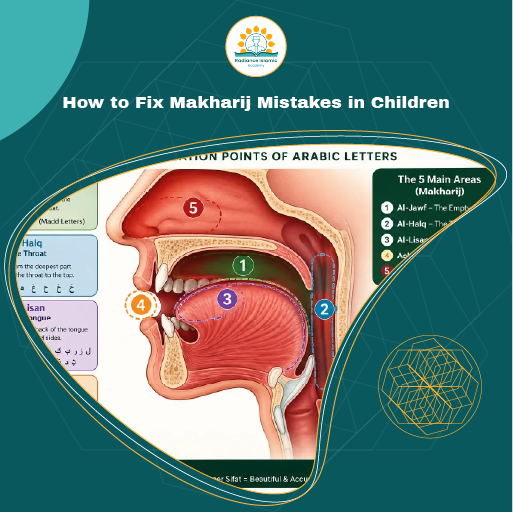
4. Your Child Repeats Makharij Mistakes
Some children can read the correct letter but produce its sound from the wrong articulation point.
This may cause similar letters to sound alike or make a letter too heavy, light, or unclear.
General reading practice may not fix a repeated Makharij problem.
The child may need focused sound modeling and repetition.
For the detailed correction path, continue with How to Fix Makharij Mistakes in Children.
5. Pronunciation Mistakes Are Becoming Part of Hifz
A repeated mistake matters more when the child memorizes it.
If unclear pronunciation becomes attached to a memorized ayah or surah, the child may repeat the same mistake automatically during revision.
This does not mean Hifz should stop.
It means pronunciation correction should become part of the memorization process.
For the wider Hifz framework, continue with Complete Guide to Quran Memorization for Kids.
6. Your Child Avoids Reading Aloud Because of Correction
A child may understand the lesson but become nervous about making mistakes.
Watch for:
- Refusing to recite
- Whispering instead of reading clearly
- Becoming upset before class
- Giving up quickly after correction
This may point to a teacher-fit or correction-style problem rather than a lack of ability.
Tajweed teaching should improve accuracy without making the child afraid to recite.
7. Correction Works During the Lesson but Disappears Later
This is an important sign.
If the child can repeat the teacher correctly but returns to the same mistake later, the correction has not transferred.
Use this learning loop:
Child recites
↓
Teacher identifies one mistake
↓
Teacher models the correction
↓
Child repeats
↓
Child applies it in another word or ayah
↓
Teacher checks it again later
The strongest progress happens when the child can use the correction outside the exact example the teacher gave.
The Reading-or-Tajweed Diagnosis Test
Use this simple test:
| Ask This Question | If the Answer Is No | If the Answer Is Yes |
|---|---|---|
| Can the child recognize the letters? | Reading foundations | Continue |
| Can the child decode short words? | Reading practice | Continue |
| Can the child read without guessing most words? | Reading fluency support | Continue |
| Are pronunciation mistakes repeating? | General reading may be enough | Tajweed/pronunciation support |
| Can the child apply correction later? | Focused correction needed | Skill is becoming stable |
| Are errors entering memorized surahs? | Monitor | Tajweed should support Hifz |
This keeps the decision simple:
Cannot read accurately → reading support first.
Can read but repeatedly recites inaccurately → Tajweed support may be appropriate.
When Tajweed Lessons May Not Be the First Step
Tajweed may not be the first priority when the child:
- Cannot recognize Arabic letters
- Cannot read short vowel patterns
- Guesses most Quran words
- Cannot join letters reliably
- Becomes overwhelmed before meaningful recitation begins
In these cases, reading foundations may need attention first.
Tajweed does not disappear from the learning path.
It is introduced when the child can benefit from correction during real reading or recitation.
How Radiance Islamic Academy Helps Identify the Right Starting Point
Once parents notice repeated recitation mistakes, the next question is:
“Is this a reading problem, a pronunciation problem, or a Tajweed problem?”
At Radiance Islamic Academy, an assessment or trial can check:
- Quran reading ability
- Repeated pronunciation mistakes
- Makharij issues
- Tajweed application
- Hifz-related errors
- Confidence during recitation
- First correction priority
The parent should then receive a recommendation explaining:
- Whether reading support should come first
- Whether focused pronunciation correction is needed
- Whether Tajweed lessons are appropriate now
- Which mistake should be corrected first
- What should be practised at home
- How improvement will be reviewed
The goal is to identify the correct starting point before choosing a class format.
Learn More About Radiance Islamic Academy

Parents can visit Radiance Islamic Academy’s official Facebook, Instagram, and WhatsApp channels to review communication, updates, and enrollment information.
These channels provide supporting context.
The final learning decision should still depend on assessment, teacher fit, correction quality, child comfort, and visible progress.
Parent Decision Check
Before choosing Tajweed lessons, ask:
- Can my child already read enough for real recitation correction?
- Which mistake repeats most often?
- Is the problem decoding, pronunciation, Makharij, or Tajweed application?
- Does the same error appear in memorized surahs?
- Can my child apply correction in a new ayah?
- Is the teacher able to explain the first priority clearly?
If these questions are still unclear, begin with a recitation assessment rather than choosing a Tajweed course by guesswork.
Frequently Asked Questions
Your child may need Tajweed lessons when they can already read or recite Quran but repeatedly make pronunciation, Makharij, Madd, stopping, or Tajweed application mistakes.
If the child still struggles to recognize letters, decode words, or read basic vowel patterns, reading foundations usually need priority.
Yes. Tajweed correction can help prevent repeated pronunciation mistakes from becoming part of memorized recitation.
The child likely needs more guided recitation practice and live correction rather than more rule explanation.
Look for fewer repeated mistakes, better pronunciation in new ayat, fewer teacher prompts, and correction that remains stable across later lessons.
Conclusion: Look for Repeated Patterns, Not One Mistake
Your child does not need a Tajweed course because of one occasional mistake.
Look for patterns.
If the child cannot decode Quran words reliably, reading foundations may need attention first.
If the child can read but repeatedly struggles with pronunciation, Makharij, stopping, or applying Tajweed, focused Tajweed support may be the better next step.
The decision should follow this order:
- Identify the repeated problem.
- Decide whether it is reading or recitation.
- Correct one priority.
- Check whether the correction transfers.
- Review the same skill later.
The goal is not to add another class.
It is to give the child the type of support that matches the real problem.
Next Step
If your child appears ready for Tajweed support, continue with Online Tajweed Classes for Kids.
If Makharij is the main problem, continue with How to Fix Makharij Mistakes in Children.
If the mistakes are entering memorized surahs, continue with Complete Guide to Quran Memorization for Kids.