Why the first lesson matters
For most children, the first lesson is the first time they learn the Qur’an with someone on a screen. For parents, it answers two questions at once: is this the right teacher, and where does my child really stand?
At Radiance, the teacher your child meets in the first lesson is the teacher who stays with them, week after week. So the first lesson isn’t a meeting with a stranger you may never see again. It’s the beginning of something you can build on.
Before the lesson
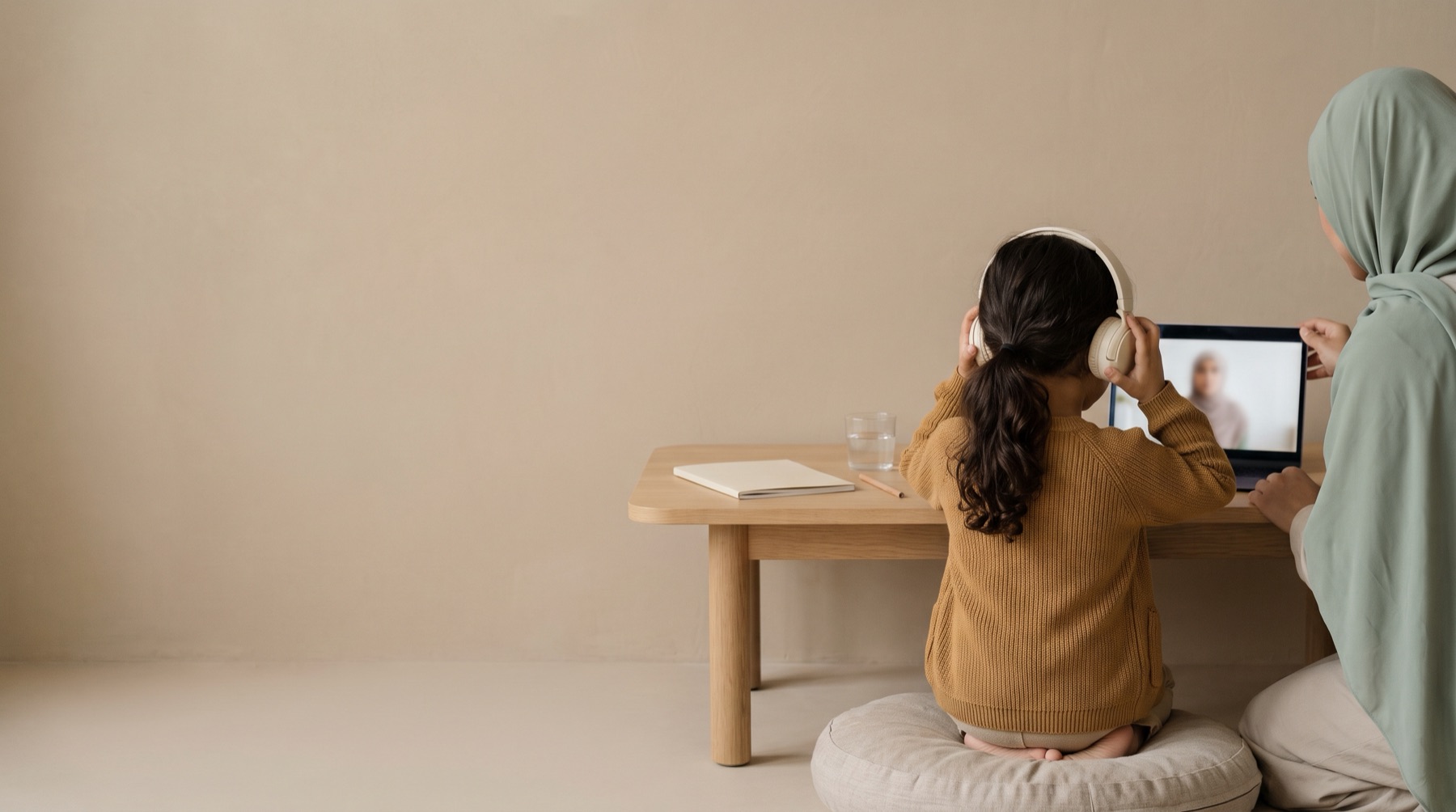
There is very little to prepare, and your child doesn’t need to practise beforehand. The teacher wants to hear them as they are. A few small things help:
- A quiet corner with a computer, tablet or phone and a steady internet connection. Lessons are live on Zoom.
- Headphones, if the room is busy. They help a young child hear the sound of each letter clearly.
- The book your child already reads from, if they have one.
- Five minutes early, so you’re ready when the teacher joins.
During the lesson
Every child is different, but the half hour usually follows the same calm shape:
Getting to know each other
The teacher greets your child and asks about them: their age, what they already know, what they enjoy. Shy children often relax once someone asks about something they love.
Listening
Your child reads or recites something they know. For one child that is the first letters of the alphabet; for another, a short surah or a full page. No starting point is too small.
Finding the level
The teacher listens closely to how your child reads and pronounces, corrects gently where it helps, and lets them ask questions.
Talking with you
In the last few minutes, the teacher tells you plainly where your child would begin, and how the lessons would go from there.
The first lesson isn’t a test your child passes or fails. It’s how the teacher learns where to begin.
Should you sit in?
Yes, if you’d like to. You can join any lesson, at any time: the first one and every one after it. With young children, we’d like a parent to be nearby, and the teacher may ask for this.
If you do sit in, three small things make a difference: sit a little out of the camera’s view, let your child answer for themselves and save your own questions for the end.
Who will teach your child
Girls and women are always taught by women, and men by men. For young boys, you choose a man or a woman; older boys are taught by men. Between them, our teachers speak Arabic, English, French, Italian, German and Spanish, so your child can usually be taught by someone who explains in a language they know.
After the lesson
If you’d like to continue, you choose one of four plans, and your child’s lessons are set at fixed times on your clock, with the same teacher. After every lesson, the teacher writes you a short report: what your child covered, where they stopped and what to practise before the next lesson.
If it isn’t right for you, you simply stop there. There’s nothing to cancel and nothing to sign.
Three questions to ask the teacher
- Where would my child start, and why there?
- What can we practise at home this week?
- How will I know my child is making progress?
The last one has a simple answer at Radiance: a written report after every lesson, and weekly and monthly tests whose results the teacher shares with you.
Questions parents ask
Is the first lesson really free?
Yes. It lasts 30 minutes, there’s one for each child, and we don’t ask for a card or any commitment. Adults can have a free first lesson too.
Does my child need to know Arabic?
No. A child can start from the very first letters of the alphabet, and our teachers can explain in Arabic, English, French, Italian, German or Spanish.
What if my child is very shy?
That’s common, and the teacher expects it. The first minutes are about getting to know each other, and you can sit beside your child the whole time.
Can we choose the time?
Yes. Lessons are set on your family’s clock, wherever you live. Our team arranges the time with you on WhatsApp.