


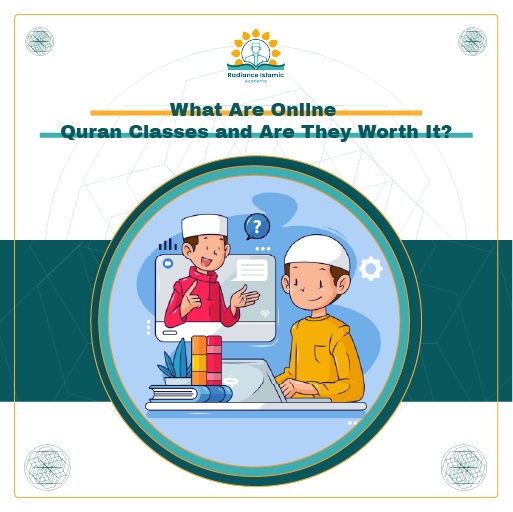
Online Quran classes are live Quran lessons taught through the internet. Instead of taking your child to a mosque, Islamic center, or local tutor, your child learns from a Quran teacher online using a video platform.
At first, this may sound simple.
A teacher appears on screen. The child reads. The teacher corrects. The lesson ends.
However, good online Quran classes are much more than a video call.
A strong class has structure, placement, revision, teacher feedback, parent communication, and a clear learning goal. For children especially, the class should feel calm, personal, and encouraging. A child should not feel like they are only staring at a screen. They should feel that a real teacher is listening, guiding, correcting, and helping them grow step by step.
That is why many parents begin here before comparing academies, prices, teachers, or free trials.
The real question is not only, “Are online Quran classes worth it?”
The better question is:
“Can this type of Quran learning help my child learn consistently, safely, and confidently?”
For many families, the answer is yes. However, the value depends on the teacher, class structure, schedule, child readiness, and how well the program fits your family’s routine.
What Are Online Quran Classes?
Online Quran classes are live, remote lessons where students learn Quran reading, recitation, Tajweed, memorization, Arabic basics, or Islamic Studies from a teacher online.
For kids, these classes are usually taught in one of three ways:
| Class Type | How It Works | Best For |
|---|---|---|
| Private online class | One teacher works with one child | Beginners, shy children, Tajweed correction |
| Small group class | A few children learn together | Confident children who enjoy interaction |
| Program-based class | Lessons follow a fixed Quran, Tajweed, or Hifz track | Children with a clear learning goal |
Most children start with basic reading or pronunciation. Then, depending on their level, they may move into Tajweed, fluency, Quran memorization, or Islamic Studies.
The most important point is this: online Quran classes are not the same as watching recorded videos.
They should be live, interactive, and guided by a real teacher. A child should listen, repeat, read, receive correction, and review previous lessons. Parents should also understand what the child needs to practice before the next class.
Once parents understand what online Quran classes actually are, the next step is learning how this decision fits into the bigger picture: teacher quality, safety, pricing, trial classes, and enrollment. That full journey is explained in The Parent’s Guide to Choosing the Best Online Quran Classes for Kids.
How Do Online Quran Classes Work?
A typical online Quran class follows a simple structure.
First, the child joins the class using a computer, tablet, or phone. Then, the teacher greets the child, reviews previous work, listens to reading or recitation, corrects mistakes, introduces a small new lesson, and gives revision for next time.
For beginners, the class may focus on Arabic letters, sounds, and joining letters into words.
children who can already read, the teacher may focus on fluency, pronunciation, and Tajweed.
For children doing Hifz, the class may include new memorization, old revision, and correction of mistakes.
A good lesson does not need to be complicated. In fact, the best online Quran lessons for kids are often simple and focused.
Simple Class Flow
A strong online Quran lesson may look like this:
- Warm greeting
- Short review
- Listening to the child read or recite
- Gentle correction
- New lesson or practice
- Quick recap
- Clear revision task
This structure helps children feel secure. They know what to expect, and the teacher can track progress over time.
Parent Insight: Children usually learn better when the lesson has a familiar rhythm. A predictable class structure helps reduce anxiety and makes Quran learning feel easier to continue.
Are Online Quran Classes Valuable for Kids?

Yes, online Quran classes can be valuable when they solve a real problem for the family and provide real learning for the child.
They are especially helpful when:
- Local Quran teachers are hard to find
- Mosque classes are too far away
- Your child needs private attention
- Your schedule is difficult
- Your child feels shy in a group
- You want more flexibility
- You want to observe the first lessons
- Your child needs Tajweed or memorization support
However, online classes are not automatically effective just because they are convenient.
A class is valuable when your child receives proper correction, feels comfortable with the teacher, attends consistently, and makes steady progress.
A class is not a good fit when it is random, rushed, passive, or poorly matched to your child’s level.
Value Box: When Online Quran Classes Make Sense
Online Quran classes usually make sense when they give your child:
- A patient teacher
- Clear correction
- A realistic schedule
- Structured lessons
- Regular revision
- A comfortable learning environment
- A reason to keep going
The value of an online Quran class is not measured by how long the lesson is. It is measured by how clearly your child is guided, corrected, and encouraged.
Why Parents Choose Online Quran Classes

Many parents choose online Quran classes because they make Quran learning easier to fit into real family life.
For example, imagine a mother whose child comes home from school tired. The local Quran class starts late, traffic is stressful, and the child resists going. After a few weeks, the family starts missing lessons.
Now imagine the same child learning from home twice a week for 30 minutes with a patient teacher. The parent can stay nearby, the child feels less pressure, and the schedule becomes easier to maintain.
That does not mean online is always better.
It means online can remove barriers that stop many children from staying consistent.
This is why 7 Benefits of Online Quran Classes Every Parent Should Know is the next natural decision point for parents who already understand the basic idea and want to know whether the benefits are strong enough for their family.
What Can Kids Learn in Online Quran Classes?
Children can learn different parts of Quran and Islamic education online, depending on their level.
Quran Reading
This is usually the starting point for beginners. Children learn Arabic letters, sounds, joining letters, short words, and reading from the Mushaf.
Quran Recitation
Children practice reading with more fluency, confidence, and correction.
Tajweed
Tajweed helps children improve pronunciation and recitation rules gradually. Younger children usually begin with simple sound correction before learning detailed rules.
Quran Memorization
Children memorize short surahs, selected portions, or longer parts of the Quran with revision and teacher correction.
Arabic Basics
Some children need Arabic letter recognition and basic reading support before they can read Quran confidently.
Islamic Studies
Some programs also include basic Islamic manners, salah, duas, stories, and age-appropriate Islamic knowledge.
The right path depends on the child.
A beginner should not be rushed into memorization before reading properly. A child who reads well may need Tajweed. A child ready for Hifz needs a revision plan, not only new memorization.
Do Online Quran Classes Really Work for Kids?
Online Quran classes work when the teacher, class structure, and home routine support the child properly.
They do not work well when the child only sits silently while the teacher speaks. They work when the child actively reads, repeats, answers, receives correction, and reviews.
The teacher must be patient. The class must be interactive. The lesson length must fit the child’s attention span. Parents should also help create a quiet space and support short revision between classes.
For many children, progress begins with small signs.
Children recognize letters faster. Students pronounce words more clearly. Learners stop fearing mistakes. They become more comfortable reading aloud. Youngsters remember short surahs better. The kids attend class with less resistance.
Parents evaluating Do Online Quran Classes Really Work? What Parents Need to Know are usually not asking for theory. They are asking, “What should real progress look like for my child?”
Signs the Class Is Working
Look for these signs:
- Your child remembers previous lessons
- Pronunciation slowly improves
- Reading becomes smoother
- The child accepts correction more calmly
- The teacher gives clear revision
- The child feels comfortable attending
- Mistakes are corrected consistently
- Progress is slow but visible
Progress does not need to be dramatic to be real.
When Are Online Quran Classes a Good Fit?
Online Quran classes may be a good fit when the child needs flexibility, individual attention, or access to a teacher outside the local area.
They may also work well for children who feel shy in groups. Some children become more confident when they learn from home. They are not worried about other students listening to their mistakes, so they participate more.
Online classes may be a good fit when:
- The child is comfortable using a screen for short lessons
- The parent can help with setup
- The teacher is patient and child-friendly
- The schedule is realistic
- The class includes revision
- The child receives personal correction
- Parents can communicate with the teacher or academy
However, online learning may not be ideal when the child strongly needs in-person social learning, cannot sit for even a short session, or has no quiet space at home.
Even then, small adjustments may help. A shorter class, better timing, or a more interactive teacher can change the experience.
Parent Insight: Sometimes the issue is not online learning itself. It may be lesson length, teacher style, timing, or the child’s starting level.
Online Quran Classes vs Traditional Quran Classes
Many parents do not want to choose online learning blindly. They compare it with traditional Quran classes first.
That is a good instinct.
Traditional classes can provide community, face-to-face learning, and a mosque environment. Online classes can provide flexibility, private attention, and access to more teachers.
The better choice depends on the child.
Parents comparing Online vs Traditional Quran Classes: Which Is Better for Your Child? usually discover that the question is not which format is universally better. The real question is which format helps their child stay consistent, comfortable, and corrected.
Quick Comparison
| Factor | Online Quran Classes | Traditional Quran Classes |
| Travel | No travel needed | Travel usually required |
| Teacher choice | Wider options | Limited to local area |
| Schedule | More flexible | Often fixed |
| Individual attention | Strong in private classes | Depends on class size |
| Community | Less in-person community | More social environment |
| Parent visibility | Easier to observe | Depends on setting |
Neither option is perfect for every family. The best choice is the one your child can continue.
What Should Parents Look for Before Enrolling?
Before enrolling your child in online Quran classes, do not focus only on price or promises.
Focus on fit.
A good online Quran class should include:
- A teacher who understands children
- A clear starting level
- Gentle correction
- Structured lessons
- Revision
- Safe communication
- Flexible scheduling
- Parent updates
- A trial or first-class assessment
- A realistic plan
Parent Decision Checklist
Before choosing, ask:
| Question | Why It Matters |
| Who will teach my child? | Teacher quality affects everything |
| Is the teacher patient with kids? | Children need gentle correction |
| What will my child study first? | Prevents wrong placement |
| How long is each class? | Lesson length affects focus |
| Is the schedule realistic? | Consistency matters |
| Can I observe the first class? | Builds trust |
| Will I get progress updates? | Helps with home revision |
A strong class should make the next step clear.
Are Online Quran Classes Worth the Cost?
Online Quran classes can justify the cost when they provide real value.
That value may include teacher quality, personal attention, structured progress, Tajweed correction, flexible scheduling, and parent communication.
However, parents should avoid choosing only by the lowest price.
A cheaper class may seem attractive, but if the teacher does not correct properly or the child does not stay engaged, the family may lose time and motivation.
On the other hand, a higher price does not automatically mean better quality. Parents should compare what is included.
Value Box
A class is usually worth paying for when it gives your child:
- A suitable teacher
- Clear correction
- A realistic schedule
- Structured progress
- Regular revision
- Confidence during lessons
- A reason to continue
The best value is not the cheapest class. It is the class your child can keep attending and benefiting from.
A Simple Parent Scenario
Imagine a father whose 8-year-old daughter knows several short surahs but cannot read smoothly from the Mushaf.
He tries to teach her at home, but she gets frustrated. The local class is too crowded, and she feels embarrassed when she makes mistakes. So he books an online trial class.
During the lesson, the teacher listens to her read a few words. Instead of correcting everything, the teacher focuses on two sounds and gives her a short practice task. The child finishes the class less nervous than she started.
That is a meaningful sign.
Not because she mastered Quran reading in one class, but because the class gave her a calm starting point.
For many parents, that is exactly what makes online Quran learning beneficial.
Final Answer: Are Online Quran Classes Worth It?
Online Quran classes are worth it when they help your child learn consistently, safely, and confidently.
They are worth considering when the teacher is patient, the lessons are structured, the schedule is realistic, and your child receives proper correction.
They are not the right fit when the class feels random, rushed, unsafe, or disconnected from your child’s level.
So the better question is not only:
“Are online Quran classes worth it?”
The better question is:
“Is this specific online Quran class right for my child?”
Start with your child’s level. Watch the teacher. Check the structure. Look at the schedule. Ask about revision. Use the first class as evidence.
Then decide.
When the class fits your child, online Quran learning can become more than convenient. It can become a steady, positive part of your child’s relationship with the Quran.
The goal is not to find the most popular academy. The goal is to find the right learning environment for your child.
For parents ready to continue the decision journey, the next step is understanding how to choose the right teacher, class format, safety standards, trial class, and enrollment path inside the main parent guide.