


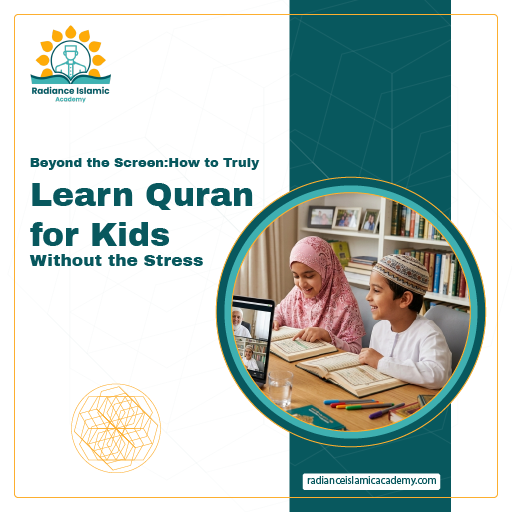
Let’s be honest: trying to learn Quran for kids after a long school day is a struggle. We’ve all been there. You set up the laptop, the teacher is waiting, and suddenly your child needs a glass of water, or their pencil is “missing,” or they just aren’t in the mood.
At Radiance Islamic Academy, we stopped trying to fight that. We realized that if we want kids to learn, we have to stop acting like robots ourselves. We believe that when you want to learn Quran for kids, it isn’t just a task to check off a list; it’s about building a connection. Sometimes that means the first 5 minutes of a lesson are spent talking about a child’s favorite toy before we even open the Qaida.
The “Secret” Benefit: Better Focus That Lasts
When families decide to learn Quran for kids, they usually think about rewards and faith. But there’s a very practical side to it too. I’ve seen this happen dozens of times: a child who can’t sit still for five minutes eventually develops what I call “learning muscles.”
It’s simple, really. When they master a tough sound like the ‘Ayn or the Haa, they are training their brain to handle difficult tasks without giving up. I remember a student named Omar who used to get so frustrated he’d almost cry when he missed a Tajweed rule. But after a few weeks of “micro-goals”—just focusing on one letter per day—his confidence shot up. Not just in Quran, but his mom told us he started finishing his math homework faster too. He just learned how to focus better over time.
How We Handle the “I’m Bored” Phase
Every child hits a wall. It’s normal. I remember once during an online session, a little girl just decided to hide under her desk. Instead of the teacher getting frustrated and telling her to “sit properly,” she started reciting the verses like a “secret code” to the girl under the desk. Within two minutes, the student was back in her chair, laughing and participating.
That’s the human touch we bring when we teach. Here’s what you can try at home:
- The “Story First” Rule: Before you ask them to memorize a verse, tell them the story behind it. If they know that Surah Al-Fil is about a giant elephant, they aren’t just memorizing sounds—they’re memorizing an adventure.
- Keep it Short: To effectively learn Quran for kids, 10 minutes of happy learning is much better than 40 minutes of tears. Consistency is what wins in the end.
Online vs. The Local Mosque: What Actually Works?
Parents often ask me which is better. To be fair, there’s no single answer. The local mosque is great for the social “vibe” and seeing other kids, which is really important for a child’s identity.
But if you choose to learn Quran for kids through online lessons at Radiance, you get something the mosque often can’t: one-on-one attention. In a big class, a shy kid might stay quiet and never correct their mistakes. Online, the teacher is 100% focused on your child’s voice. We see every little slip-up and every small win. Plus, let’s be real—not having to drive through traffic at 5:00 PM makes the whole experience much more peaceful for you. When you are relaxed, your child is relaxed.
Perfection is the Enemy of Progress
The biggest mistake we see? Parents (and sometimes teachers) being too hard on the pronunciation early on. If you correct every single tiny mistake in the first week, the child will start to hate the lessons.
We follow a “confidence first” rule. Let them get the flow right. Let them feel like they can do it. Once they love the sound of their own recitation, we start gently polishing the Tajweed. I’ve found that when a child feels proud of their progress, they actually want to get the rules right.
Let’s Start the Journey Together
Helping your child to learn Quran for kids is a marathon, not a sprint. There will be good days and “I don’t want to” days. Our job at Radiance Islamic Academy is to make sure the good days happen more often. We use teachers who actually understand kids—teachers who know when to be firm and when to tell a joke.
Want to see if we’re a good fit? Come try a session with us. No pressure, no long commitments. Just a chance for your child to meet a teacher who cares about their heart as much as their Hifz.
Why it’s Different to Learn Quran for Kids in the UK
Living in a fast-paced environment like London, Birmingham, or Manchester brings its own set of unique challenges for Muslim parents. You’re juggling school runs, after-school clubs, and the unpredictable British weather. Often, the only time left to learn Quran for kids in the UK is in the evening, when everyone is already exhausted. I’ve spoken to so many parents who feel guilty because their child is too tired to focus after a full day at school, or they dread the “Madrasah run” through peak-hour traffic and rain.
We get it. Life here doesn’t always pause for religious studies, and forcing a tired child into a rigid, traditional setting can sometimes backfire, making them feel like the Quran is a “burden” rather than a blessing. That’s why the way we approach this needs to be as modern and flexible as our lives are.
Finding the Balance Between British School Life and Quran
The biggest hurdle when you want to learn Quran for kids in the UK is time management. Our kids are navigating two worlds, and they need a tutor who understands that. I remember a student from Leeds who was struggling to balance his Hifz with his GCSE preparations. He was stressed, and his recitation was becoming mechanical. Instead of pushing him harder, his tutor started spending the first ten minutes of the lesson just talking about his school day in English.
This small shift changed everything. By acknowledging his “British” reality, the Quran lessons stopped feeling like a separate, stressful world. At Radiance Islamic Academy, we focus on this “Cultural Empathy.” Our tutors know that a child in the UK might struggle with some Arabic sounds because they speak English all day. We don’t judge; we adapt. We use relatable examples—like comparing the flow of a verse to a melody they might know—to make the rules of Tajweed stick.
For parents, my advice is to stop worrying about “perfection” right away. In the UK, our kids are exposed to so much “instant” entertainment. To keep them interested, we have to make their Quran journey feel like a win. If your child manages to learn Quran for kids in the UK for just 15 minutes with focus and a smile, that is a huge victory. We’ve found that one-on-one online sessions work best here because they cut out the travel stress. You can stay in your pajamas, have a cup of tea, and watch your child progress from the comfort of your living room. It turns a “chore” into a peaceful family ritual.
Final Thoughts: It’s About the Heart, Not Just the Homework
At the end of the day, when you decide to learn Quran for kids, you aren’t just looking for a tutor to correct a few letters. You are looking for someone to help plant a seed of love in your child’s heart. I’ve seen so many kids grow up to associate the Quran with stress because of “perfectionist” teaching styles. But I’ve also seen kids like the ones at Radiance Islamic Academy, who actually look forward to their lessons because they feel seen, heard, and encouraged.
Whether you are in the middle of a busy London suburb or a quiet town, remember that every minute your child spends with the Book is a blessing. Don’t let the “bad days” discourage you. If they only read one verse today but they did it with a smile, you’ve already won.
Questions Parents Ask Us All The Time (FAQ)
“My child is easily distracted. Is online learning really a good idea?” Honestly? It’s often better than a classroom. In a group, a distracted child just “disappears” or gets in trouble. Online, our tutors can tell the second a child’s eyes wander. We don’t yell; we change the pace. We might switch to a quick story or a game to bring them back. It’s all about keeping the energy right for your specific child.
“What’s the ‘perfect’ age to start?” Most parents start looking to learn Quran for kids around age 4 to 6. But here’s the truth: every kid is different. We’ve had 5-year-olds who are ready to dive in, and 7-year-olds who need a much slower start. The “perfect” age is whenever your child can follow a simple 10-minute conversation.
“English is our first language at home. Will they struggle with Tajweed?” It’s a common worry! But actually, kids are like sponges. While the Arabic Makharij (sounds) are different from English, a child’s vocal cords are very flexible. Our tutors are experts at bridging that gap—sometimes we even use funny English sounds to help them find where the Arabic letter should come from. They’ll get it, we promise.
“How long will it take before they can read fluently?” I wish I had a magic number, but it’s a marathon. Some kids fly through the basics in a few months, others take a year. What matters more than speed is consistency. Five minutes every day is worth more than two hours once a week.
“What if we have to miss a class because of school exams?” We live in the real world too! Especially for our students who learn Quran for kids in the UK, exam seasons are stressful. We always tell parents: don’t quit, just scale back. We can adjust the lessons to be lighter during those weeks so the child doesn’t feel overwhelmed. We’re here to support your family, not add more stress.